

Hearing the words “you’re under military investigation” hits with the force of a blast wave. One moment, your career is on track; the next, your mind races through a storm of uncertainty—your rank, your reputation, your retirement, your clearance, and even your family’s stability suddenly feel at risk. Most service members have never been through anything like this. Investigators, however, do it every day. Command teams deal with investigations constantly. The imbalance is immediate and overwhelming.
At the Law Office of Will M. Helixon, our Warrior Advocates represented more than 13,000 service members worldwide. We have seen the same patterns repeatedly, good Soldiers, Sailors, Airmen, Marines, Guardians, and Coast Guardsmen making avoidable mistakes simply because they didn’t know what to do in those first crucial hours. That is why this guide exists. These ten rules are your battle drills for surviving any military investigation. They reflect what actually protects you, what preserves your defense, and what gives you the strongest chance to save your career.
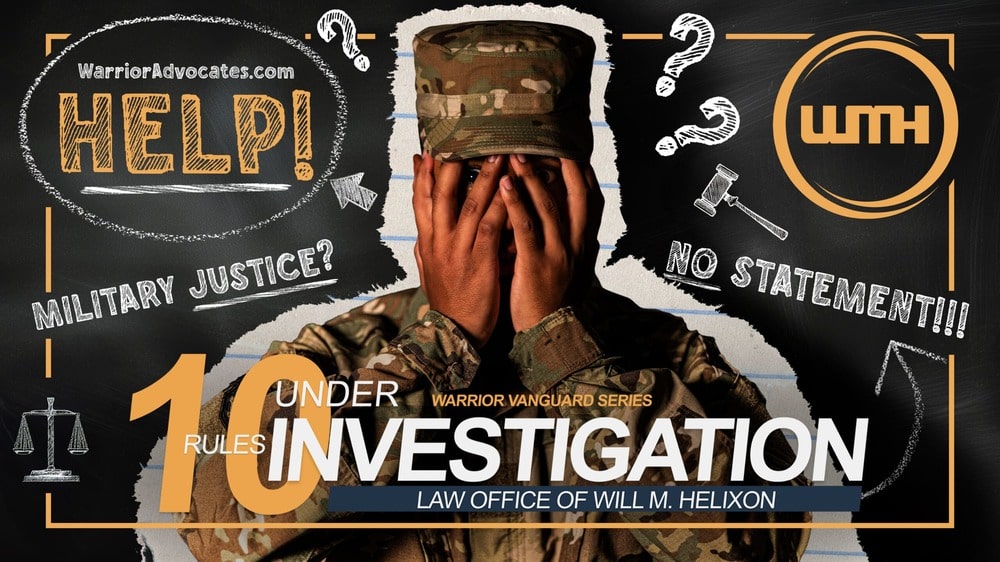
Important: This is education, not individual legal advice. Every case is different. If you are under investigation, talk to a defense lawyer now.
Rule 1: Get Legal Counsel & Know Your Rights
Warrior Law Team Tips:
- Article 31(b) is Your Shield: Investigators must inform you of the suspected offense, that you don’t have to answer, and that anything you say can be used against you.
- Investigators Are Highly Trained: They use rapport building, minimization, and false urgency to make you talk—not to help you.
- The Correct Response: Say: “I want to speak to an attorney before answering any questions.” Then stop.
Warrior Law Team Tips:
- Article 31(b) is Your Shield: Investigators must inform you of the suspected offense, that you don’t have to answer, and that anything you say can be used against you.
- Investigators Are Highly Trained: They use rapport building, minimization, and false urgency to make you talk—not to help you.
- The Correct Response: Say: “I want to speak to an attorney before answering any questions.” Then stop.
The moment you learn, or even suspect that you are under investigation, you must understand one truth: talking will not save you. In fact, talking almost always harms you. Most service members feel the instinct to explain, defend themselves, or “clear things up” because silence feels risky. But the greatest danger in any military investigation is speaking without counsel.
This is where Article 31(b) of the Uniform Code of Military Justice becomes your shield. Before questioning you about a criminal offense, investigators must tell you:
- What you’re suspected of
- That you don’t have to answer questions
- That anything you say can be used against you
- That you have the right to a lawyer and can have one present
These protections apply no matter who is asking: CID, NCIS, OSI, CGIS, MPI, Security Forces, Military Police, your commander, your first sergeant, or an AR 15-6 investigating officer.
What many service members don’t realize is that investigators are highly trained in psychological interviews. They use rapport building, minimization, false urgency, and claims of evidence that may not exist. Every tactic is designed to make you talk. None is designed to help you. The correct response to any questioning is simple and firm: “I want to speak to an attorney before answering any questions.”
Rule 2: Do Not Consent to Searches
Warrior Law Team Tips:
- Never Consent to Searches: Don’t voluntarily consent to searches of your phone, home, vehicle, workspace, or personal property.
- Comply with Lawful Orders: If a commander issues a valid search authorization or police execute a warrant, you must comply—but always state you don’t consent.
Warrior Law Team Tips:
- Never Consent to Searches: Don’t voluntarily consent to searches of your phone, home, vehicle, workspace, or personal property.
- Comply with Lawful Orders: If a commander issues a valid search authorization or police execute a warrant, you must comply—but always state you don’t consent.
In today’s military justice environment, your phone is often the centerpiece of the government’s case. It contains your messages, photos, location data, app usage, and years of personal context. Investigators know this. That is why they ask for your passcode, your devices, or your “permission” to take a look. They may frame it as a minor request or suggest it’s an opportunity to prove your innocence.
Never fall for this.
You should never voluntarily consent to any search of your phone, your home, your vehicle, your workspace, your digital accounts, or your personal property. The correct response is always: “I do not consent to any search.”
There are situations in which you must comply, for example, if investigators present a valid search authorization from a commander, magistrate, or civilian judge. You must also comply with lawful orders for fingerprints, DNA, or breath samples. But even when you must comply, you protect yourself by clearly stating that you do not consent. This prevents the government from claiming you cooperated voluntarily and allows your defense team to challenge the legality or scope of the search if needed.
When Must a Subject Comply with Searches, and When Are They Exempt?
MUST Comply
- Lawful written search authorization from a commander
- Valid warrant issued by a judge to civilian police
- Direct orders for fingerprints, DNA swabs, or breath samples under proper authority
- Routine inspections and procedures (gate inspections, unit health checks)
Exempt (Can Say No)
- Requests to “sign a consent form” or “give us your passcode” without a warrant
- Voluntary consent requests like “let us take a quick look”
- Requests to unlock your phone or provide personal passwords
- Any request presented without showing valid warrant or written authorization
Rule 3: Preserve All Evidence
Warrior Law Team Tips:
- Preserve Everything: From the moment you know you’re being scrutinized, save relevant chats, download important emails, and back up your data.
- Keep a log of contacts: Note the date, time, and subject of conversations about the incident.
- Never delete anything: Deleting messages, threads, or emails can make you look like you’re hiding something and may be treated as obstruction of justice.
Warrior Law Team Tips:
- Preserve Everything: From the moment you know you’re being scrutinized, save relevant chats, download important emails, and back up your data.
- Keep a log of contacts: Note the date, time, and subject of conversations about the incident.
- Never delete anything: Deleting messages, threads, or emails can make you look like you’re hiding something and may be treated as obstruction of justice.
One of the most common mistakes service members make is deleting messages, clearing conversations, or discarding documents because they believe it makes them look bad. Even when the intention is innocent, deletion can be perceived as destruction of evidence, a serious issue that can be used to damage your credibility or imply guilt.
Instead, you must preserve everything exactly as it is.
Save text messages, export full conversations, download important emails, and back up any digital content that might be relevant. Maintain copies of travel records, receipts, fitness tracker data, photos, duty rosters, and any calendar entries that may support your timeline. You should also begin keeping a log of any contact related to the case, including conversations with command or investigators.
It is not your job to decide what helps or hurts you. It is your lawyer’s job to evaluate the evidence and determine how it fits into a defense strategy. Your job is to keep everything intact.
How Evidence Should be Preserved for a Military Investigation
Evidence should be preserved intact, organized, and secure. Follow these steps:
Digital Content: Take clear screenshots that show the entire conversation, including dates, times, and contact names, and then back up those screenshots in at least one additional location that you control. Where possible, export complete chat histories or email threads rather than isolated messages to avoid losing context.
Physical Documents: Keep the originals flat and dry, and consider making scanned copies or clear photos as backups. Avoid writing notes directly on original evidence; if you need to annotate something, do it on a copy.
Delivery to Your Attorney: The safest approach is to preserve everything exactly as you have it, then deliver it securely to your attorney following their instructions. Do not send sensitive material through unsecured channels or group chats. Your lawyer will advise you on proper storage, duplication, and sharing methods without compromising the evidence or creating new legal issues.
Subscribe on YouTube to get notified when it launches.

Rule 4: Control All Communications
Warrior Law Team Tips:
- Keep Quiet: Don’t discuss the case with your ex, parents, battle buddies, squad, or potential witnesses. The only safe place to talk is with your attorney.
- Avoid Social Media: A single vague post about being falsely accused or targeted becomes evidence.
Warrior Law Team Tips:
- Keep Quiet: Don’t discuss the case with your ex, parents, battle buddies, squad, or potential witnesses. The only safe place to talk is with your attorney.
- Avoid Social Media: A single vague post about being falsely accused or targeted becomes evidence.
Communication is one of the most dangerous parts of any military investigation, and one of the most underestimated. Even well-meaning conversations with friends, family members, or fellow service members can end up misquoting, misunderstanding, or being used against you. Talking about your case increases the risk of accidental inconsistencies, gossip, or allegations of collusion or witness tampering.
The safest and only appropriate place to discuss your case is with your lawyer. You should not talk about the facts with anyone else, including your spouse, significant other, parents, NCOs, coworkers, subordinates, or witnesses. The fewer people who hear your version of events, the safer you are.
This rule extends to social media. A single vague post about being falsely accused, feeling targeted, or being involved in an investigation can easily become evidence. Comments on articles, posts about your activities, or even likes on certain content can be used to shape a narrative about you. It is best to avoid posting altogether until the military investigation concludes.
Rule 5: Route All Command and Investigator Contact Through Your Lawyer
Warrior Law Team Tips:
- Direct All Communication to Your Lawyer: Say: “I have been advised not to discuss this matter without my attorney. Here is my lawyer’s contact information.”
- Written Questions Only: Live interviews leave words open to misquotation. Insist on written questions so your lawyer can review and object.
- Your Lawyer is Your Air-Traffic-Controller: Route all communications through your attorney. They decide which require action and how to respond.
Warrior Law Team Tips:
- Direct All Communication to Your Lawyer: Say: “I have been advised not to discuss this matter without my attorney. Here is my lawyer’s contact information.”
- Written Questions Only: Live interviews leave words open to misquotation. Insist on written questions so your lawyer can review and object.
- Your Lawyer is Your Air-Traffic-Controller: Route all communications through your attorney. They decide which require action and how to respond.
Once you are under investigation, you should not have direct substantive conversations with the command or investigators about the case. Many service members feel intimidated when approached unexpectedly by agents or senior leaders, and they answer questions without thinking or fall into small talk that reveals more than intended.
Your lawyer must become the point of contact for everything. If someone approaches you about the case, the correct response is brief, polite, and unwavering: “I have been advised not to discuss this matter without my attorney. Here is my lawyer’s contact information.”
You do not need to explain yourself. You do not need to justify your silence. You do not need to engage in follow-up conversations. From that moment on, your attorney handles all communications, evaluates all requests, and responds strategically.
Keeping a simple log of all contacts who approached you, when, and what they wanted, also helps your lawyer understand the military investigation trajectory.
Best Practices for Handling Investigator or Command Contact During Military Investigations
Step 1: In-Person Approach
Agent or commander approaches unexpectedly? Stay polite, firm, and brief. Say: “I am not comfortable discussing this without my attorney present.” If they continue, repeat that line and ask for their contact information.
Step 2: Avoid Small Talk
Don’t get drawn into casual conversation about the facts, even if it feels harmless.
Step 3: Written Contact
Receive a text, email, or appointment memorandum? Don’t reply with explanations. Acknowledge receipt if you must, then immediately forward to your attorney and wait for guidance.
Step 4: Keep Records
Maintain a log of who contacted you, when, and about what. Share it with your lawyer.
Step 5: Official Directives
Never ignore official orders or directives. Bring them to your counsel immediately so you can comply without surrendering your rights.
Rule 6: Obey All Orders and Restrictions
Warrior Law Team Tips:
- Comply with MPOs, CPOs, and No Contact Orders: No matter how unfair they feel, comply completely.
- Retaliation or UCI: If orders feel retaliatory or unlawful, obey them first, then fight through proper channels.
- Document Compliance: Keep a factual daily log of check-in times, locations, who you reported to, and any changes to duties or restrictions.
Warrior Law Team Tips:
- Comply with MPOs, CPOs, and No Contact Orders: No matter how unfair they feel, comply completely.
- Retaliation or UCI: If orders feel retaliatory or unlawful, obey them first, then fight through proper channels.
- Document Compliance: Keep a factual daily log of check-in times, locations, who you reported to, and any changes to duties or restrictions.
When you are under investigation, you may receive orders, restrictions, or directives that feel unfair or embarrassing. You may be told not to contact someone, restricted to post, reassigned to different duties, or required to comply with conditions that disrupt your daily life.
No matter how frustrating these restrictions may feel, you must obey them completely. Violating a Military Protective Order, a no-contact order, or a restriction of movement can lead to additional charges that are often much easier to prove than the underlying allegation. Even if the order seems retaliatory or misguided, compliance protects you. You and your lawyer can challenge the order through proper channels later.
Keeping a written record of your compliance where you were, when you checked in, and any interactions with command can later become a crucial piece of evidence demonstrating your professionalism and reliability during one of the most difficult periods of your career.
Typical Types of Orders During a Military Investigation
Order Type
Examples
Typical Types of Orders During a Military Investigation
| Order Type | Examples |
| Written | Military Protective Orders, memorandum-based no-contact orders, travel restrictions, written taskers changing your duties |
| Verbal | Commander directing you not to discuss the case, first sergeant ordering you to report to specific locations at certain times, supervisor assigning new working hours or responsibilities |
| Administrative | Flags barring favorable actions, removal from leadership positions, schools, or boards |
Follow us for expert military law tips.
Rule 7: Prioritize Health and Well-Being
Warrior Law Team Tips:
- Take Care of Yourself: Stress from the investigation can lead to bad decisions. Manage it deliberately and responsibly.
- Workout: Exercise, journal, and meditate within your restrictions. Show decision-makers you’re disciplined, not falling apart.
- Consult Chaplain or Behavioral Health: Talk about your stress (not case facts) with chaplains or behavioral health providers.
Warrior Law Team Tips:
- Comply with MPOs, CPOs, and No Contact Orders: No matter how unfair they feel, comply completely.
- Retaliation or UCI: If orders feel retaliatory or unlawful, obey them first, then fight through proper channels.
- Document Compliance: Keep a factual daily log of check-in times, locations, who you reported to, and any changes to duties or restrictions.
A military investigation takes a real toll on mental and emotional health. Many service members experience disrupted sleep, anxiety, isolation, and fear of the unknown. Others withdraw, stop working out, or begin making impulsive decisions that worsen their situation. What feels like a personal crisis can quickly become a professional one if you do not deliberately take care of yourself.
The healthiest path through an investigation includes maintaining a structured routine. Continue exercising within your limits. Journal about your experiences. Spend time with trusted friends who are not connected to the case. Most importantly, seek support from:
- Behavioral Health Clinics: Offer assessment and counseling to manage stress and mental health during the investigation.
- Chaplains: Provide confidential support and can connect you with faith-based or non-faith-based resources.
- Military and Family Life Counselors: Meet with you or your family to discuss stress, communication problems, or the investigation’s impact on your home life.
- Substance Use Programs: Help if alcohol or drugs have become a way of coping.
- Support Groups: On and off-post organizations like Alcoholics Anonymous connect you with others who have struggled.
Seeking help demonstrates maturity and responsibility. It also ensures you stay clear-headed and capable of making good decisions while the case unfolds.
Rule 8: Begin Building Your Defense Immediately
Warrior Law Team Tips:
- Do NOT Call Witnesses: Don’t contact witnesses about the case or try to persuade them to tell a certain story. That’s witness tampering.
- Gather Evidence: Write a detailed timeline. List potential witnesses with contact info—don’t call them. Collect all documents: duty rosters, receipts, bank statements, travel records. Give everything to your lawyer.
Warrior Law Team Tips:
- Comply with MPOs, CPOs, and No Contact Orders: No matter how unfair they feel, comply completely.
- Retaliation or UCI: If orders feel retaliatory or unlawful, obey them first, then fight through proper channels.
- Document Compliance: Keep a factual daily log of check-in times, locations, who you reported to, and any changes to duties or restrictions.
While the government investigates, you must build your defense. Many service members make the mistake of waiting until charges are preferred or until command acts before getting serious about their defense. By that time, critical evidence may be lost, or witnesses may have forgotten key details.
The foundation of your defense begins the moment you learn someone made an allegation or that investigators are asking questions. Start by writing a detailed timeline. Even small details that seem insignificant now may become critical later. Think through who might have relevant information, but do not contact them yourself. Collect official records, such as duty rosters, leave forms, training schedules, appointment slips, pay records, and travel documents.
Defense is like building a brick wall with bricks. The earlier you start and the more consistently you work, the stronger that wall becomes when the government presents its version of events.
Types of Evidence Supporting a Defense
Different cases call for various types of evidence, but several categories are commonly useful.
Evidence Type
Examples
What It Shows
Types of Evidence Supporting a Defense
Different cases call for various types of evidence, but several categories are commonly useful.
| Evidence Type | Examples | What It Shows |
| Digital Communications | Text messages, group chats, emails, direct messages | Who you talked to, what was said, and when |
| Location Evidence | Phone location history, app check-ins, ride-share records, fuel receipts, gate logs | Where you were or were not at critical times |
| Administrative and Official Records | Duty rosters, training schedules, counseling statements, NCOERs and OERs, leave forms, pass forms, medical appointment records, evaluation reports | Your duties, performance, and whereabouts |
| Financial Records | Bank statements, government travel card reports, pay records | Travel, purchases, or inactivity during alleged incidents |
| Photos and Videos | Visual content from your phone or others | Visual context of events |
| Character Evidence | Awards, decorations, commendations, letters from supervisors or peers, volunteer work, and community involvement | A complete picture of who you are |
Rule 9: Obtain Records Properly
Warrior Law Team Tips:
- Don’t Do-It-Yourself: Don’t attempt to access records outside your normal role—it can look like you’re sanitizing evidence.
- Use Official Channels: Your lawyer will use official channels—FOIA, Privacy Act, discovery demands, subpoenas, or court orders—to obtain records correctly.
Warrior Law Team Tips:
- Comply with MPOs, CPOs, and No Contact Orders: No matter how unfair they feel, comply completely.
- Retaliation or UCI: If orders feel retaliatory or unlawful, obey them first, then fight through proper channels.
- Document Compliance: Keep a factual daily log of check-in times, locations, who you reported to, and any changes to duties or restrictions.
Never attempt to gather sensitive or official records in a way that could be misinterpreted. Accessing systems outside your normal responsibilities, pulling files you have no routine reason to view, or trying to obtain documents through unofficial means can create new problems or suggest you were trying to manipulate evidence.
Your lawyer has access to formal, lawful channels for FOIA requests, Privacy Act requests, subpoenas, discovery demands, and court orders to obtain the records your defense needs. Tell your attorney what records exist and why they may matter. They will decide the safest, most strategic way to obtain them.
How to Request Military Records
You have routine rights to access your personnel file, medical records, evaluations, and orders. Coordinate with your lawyer to decide which requests should come from you and which from counsel. Often, the safest approach is to authorize your attorney to obtain records on your behalf.
Step 1: Identify the Office
Determine which office holds the records: human resources, medical, legal, finance, or your branch’s personnel center.
Step 2: Submit a Written Request
Submit a written request in the format that office requires.
Step 3: Consider Formal Requests
For older or archived records, your lawyer may use centralized repositories, online systems, or draft a Privacy Act or FOIA request—particularly if there’s concern someone in your chain of command might limit what you see.
Watch rule-by-rule video shorts as they release.
Rule 10: Remain Professional and Compliant
Warrior Law Team Tips:
- Be Your Best: Be early, wear the correct uniform, and execute assignments without grumbling. Show resilience and professionalism.
- No Additional Misconduct: Don’t pick up new charges. Months of clean conduct show you as a one-time incident, not a pattern.
- Go the Extra Mile: Volunteer for legitimate duties your chain of command and lawyer approve. Show you continue serving the team.
Warrior Law Team Tips:
- Comply with MPOs, CPOs, and No Contact Orders: No matter how unfair they feel, comply completely.
- Retaliation or UCI: If orders feel retaliatory or unlawful, obey them first, then fight through proper channels.
- Document Compliance: Keep a factual daily log of check-in times, locations, who you reported to, and any changes to duties or restrictions.
How you conduct yourself during a military investigation matters more than most service members realize. Commanders, JAGs, administrative boards, and panels consider not just the allegation but the person standing in front of them. Professionalism during adversity becomes part of your defense.
Being early to formations, maintaining your uniform standards, performing your duties without complaint, and avoiding any additional misconduct, all help shape the narrative that you are disciplined, trustworthy, and stable under pressure. Months of clean, professional conduct can be the difference between a command of seeing you as a one-time accused service member or as someone with a pattern of issues.
Your compliance log reinforces this narrative. Together, your behavior and your documentation create a powerful “black box” of who you were when the system was weighing judgment.
Frequently Asked Questions (FAQs)
When Will I be Interviewed?
There is no set schedule for a suspect interview. In most criminal investigations (CID, NCIS, OSI, CGIS, MPI), agents interview the accuser and key witnesses first, then request a suspect interview once they believe they can confront you effectively. This often comes through your chain of command and may happen with little or no warning.
In command-directed investigations (AR 15-6, CDIs), interviews can happen early, late, or not at all; timing depends entirely on the investigating officer’s approach.
You may be interviewed multiple times or never, which is why the real issue isn’t when the interview happens, but how you respond. Investigators can approach you anywhere—your unit, home, or by phone, and will often say they “just want your side.”
Your protection is Article 31(b). Use it the moment contact begins:
“I want to speak to an attorney before I answer any questions.”
This stops the interview at any time, under any agency.
Who Investigates Military Crimes and Misconduct?
Multiple agencies may investigate your case, sometimes at the same time. The primary felony-level military investigative agencies are:
- Army CID: An independent federal law-enforcement agency within the Army investigating felony-level misconduct.
- NCIS: A civilian-run federal agency under the Department of the Navy protecting the Navy and Marine Corps worldwide, handling major criminal offenses, counterintelligence, and terrorism threats.
- OSI: The Department of the Air Force’s federal investigative service responsible for criminal investigations and counterintelligence for the Air Force and Space Force.
- MPI: The Department of the Army misdemeanor offense investigative agency, responsible for criminal investigations not handled by CID.
- Marine Corps CID: A Department of the Navy law-enforcement organization embedded in the Provost Marshal’s Office. Conducts misdemeanor and felony investigations when NCIS does not take the lead.
- CGIS: Coast Guard Investigative Service investigating UCMJ violations and maritime-related crimes. They handle sexual assault, child abuse, major fraud, serious drug offenses, homicide, procurement fraud, and other large-scale offenses.
Outside the installation, civilian police, federal agencies (FBI/HSI), and host-nation authorities overseas may also investigate depending on jurisdiction.
How Long Does a Military Investigation Take?
There is no guaranteed timeline. Based on our combined centuries of military law experience, it’s fair to say that most meaningful criminal investigations (by CID, NCIS, OSI, or CGIS) last at least a few months, and 6–12 months is very common in serious cases, with some dragging on for 18 months or more. Administrative command investigations, such as AR-15 6 inquiries and command-directed investigations, are often faster on paper but still frequently take several weeks to several months
Criminal investigations run long because agents must analyze digital evidence, send items for forensic testing, track down witnesses across units or countries, and coordinate with prosecutors. Forensic delays, especially DNA, digital extractions, and lab backlogs, often add significant time.
Administrative investigations (AR 15-6, CDIs) are faster on paper but still commonly take weeks to months.
Expect delays from:
- multiple agencies coordinating
- PCS, deployments, and witness availability
- expert analysis
- legal reviews and requests for more information
- overseas SOFA processes
The most realistic answers: plan for months, prepare for a year, and use that time to wisely preserve evidence, follow orders, control communication, and work with counsel to build your defense.
What Triggers a Military Investigation?
Military investigations don’t require evidence—just a report or complaint. A single allegation is usually enough to open a case.
Common Triggers
- Reports to Law Enforcement: A victim, witness, or commander reports a potential crime (sexual assault, theft, drug use, etc.). The allegation alone is sufficient to start an investigation.
- Drug Tests: A positive urinalysis can immediately trigger command notification, law enforcement referral, and possible expanded searches or criminal charges.
- Traffic Stops & Accidents: A DUI/DWI stop, vehicle inspection revealing drugs, or serious traffic accident can launch investigations. Fatal or serious-injury accidents automatically trigger both safety and legal investigations.
- Administrative Channels: Inspector General complaints, Equal Opportunity complaints, or Congressional inquiries can trigger command or law enforcement investigations.
- Civilian Legal Actions: Allegations in divorce proceedings, custody battles, or protective order petitions often reach your chain of command and trigger military investigations.
- Online Crimes: CyberTipline reports, undercover operations, or evidence of online child exploitation can trigger immediate investigations involving military law enforcement.
- Internal Command Concern: Commanders can initiate investigations based on rumors, anonymous notes, patterns of misconduct, or pressure from higher headquarters—no formal complaint needed.
What is the Difference Between a Law Enforcement Investigation and a Command-Directed Investigation (AR 15-6), and Does it Matter?
| Law Enforcement Investigation | Command Investigation (AR 15‑6) |
| Run by: CID, NCIS, OSI, or civilian police | Run by: Your chain of command |
| Goal: Prove a crime for prosecution | Goal: Administrative fact-finding |
| Your rights: Article 31(b) warning, right to remain silent, right to a lawyer | Your rights: Limited; may be pressured to “cooperate” but Art. 31(b) applies |
| Standard of proof: Probable Cause (reasonable evidence crime happened) | Standard of proof: Preponderance of evidence (more likely than not) |
| Main risk: Criminal conviction, confinement, discharge, fines, permanent record | Main risk: Career damage—GOMORs, bad OERs, separation, loss of promotion for years |
Critical: Many serious events trigger both investigations at the same time. An AR 15‑6 can feed into or transform into a criminal case. In either situation, get a lawyer immediately and do not give statements.
Your Defense Starts Today
A Military Investigation Moves Faster Than You Think
A military investigation does not wait for you to catch up. Evidence is collected behind the scenes; witnesses are contacted early, and preliminary assessments are often made long before you know an allegation even exists. What feels like silence is momentum that you must counter immediately if you want to protect yourself.
Waiting is not a protection. Hoping it will “resolve itself” is not a strategy. Assuming the truth will prevail on its own is one of the most dangerous beliefs a service member can have during an investigation.
How We Protect You
The Law Office of Will M. Helixon is built for moments like this. Our team knows how CID, NCIS, OSI, CGIS, MPI, security forces, base police, and AR 15-6 investigations operate. We know what investigators look for, what commanders respond to, and how early intervention changes outcomes.
We help you invoke your Article 31(b) rights correctly; stop improper interviews before they begin; prevent unauthorized searches; preserve evidence without risking accusations of tampering; and build your defense using timelines, witness analysis, documentary evidence, and expert insights. Our job is to stand between you and the system, ensuring you do not make mistakes that cannot be undone.
Contact The Law Office of Will M. Helixon
Your career, rank, retirement, benefits, reputation, and family stability are not abstract concerns; they are the stakes. Every decision you make now matters more than any routine choice you have made in your military life. The earlier your defense team steps in, the more control you regain.
If you think you are under investigation, if someone has made an allegation, if CID, NCIS, OSI, CGIS, MPI, or your chain of command has contacted you, or even if you simply have a feeling that something is happening behind the scenes, your defense must start today. You defend the Nation. We defend you. Schedule your confidential consultation today.
Transcript
Transcript of “10 Rules – Investigation” Video
Will M. Helixon (00:31):
Hey, Warrior. So you found yourself under investigation. First off, don’t panic. You’re not alone, and you have certain rights. You’ve taken the first step by watching this video. Today, we’re breaking down your personal playbook so you can protect yourself, your family, and your career, and do it like a pro. Y’all ready? Let’s roll.
CID Agent (01:08):
It is time you tell us what happened. You have been sitting here long enough.
Kyle Miesner (01:22):
Could you give us a little [rushes off CID Agent]…
Rule Number One: Invoke and get Experienced Civilian Defense Counsel.
That means lawyer up! And NO! NO! That doesn’t mean getting advice from your buddy who’s watched every season of NCIS. So, anyway, politely decline questions. Say I’d like to speak to a lawyer and then ZIP IT! Polygraph? Not a chance! Remember, stop talking about the case entirely. At this point, your lawyer is the only one who’s really on your side. Tea?
Cadman Kiker (02:11):
Rule Number Two: Don’t Consent to any Searches.
Your car, your DNA, your home, no sneaky swipes. Just say no. Comply with lawful orders. But don’t give over your passcode. Treat your personal space like the crown jewels.
Laura Kiker (02:34):
That means when CID comes crashing through your home…
Cadman Kiker (02:42):
I didn’t say come in.
CID Agent (02:44):
I mean, we’re already here.
Laura Kiker:
You ask them to leave.
Cadman Kiker:
YELLING: Get the hell out of my house!
Laura Kiker:
Maybe a little nicer.
Cadman Kiker (02:57):
Can you “please” get the hell out of my house?
Laura Kiker (03:00):
That’s better.
Liz Talarico (03:10):
[Whispering] Come on over here.
Liz Talarico (03:18):
Over here. Deleting messages are not a good idea. What? But let me quickly get out of here. [Steps out of the Television Screen]
Liz Talarico
Rule Number Three: Preserve Evidence.
And don’t delete backup data. Take screenshots and keep a log of all of your contacts. Think of yourself as an evidence archivist.
Captain Backup, if you will. Every text, every thread. See it as creating a barrier around you – an armor around you – so you’re ready for what comes next. Even if it’s hard to see sometimes. Can somebody get
Liz Talarico (04:08):
Can someone get this off of me?
Soldier 2: (04:11):
Excuse me, my friend’s asking what’s going on? Can I tell him?
Scott Brokaw:
Nope.
Soldier 2:
Just a little.
Scott Brokaw:
Nope.
Soldier 2:
Not even a little.
Scott Brokaw:
No. People talk. You never know when information might spill out that could harm your case. Besides, you don’t really know what’s going on behind the scenes.
Soldier 2:
Alright, got it.
Scott Brokawy:
Rule four: Shut the Fu*k up! Control Communications.
Do not discuss your case with anyone. No family, no friends, no high school lab partner, no social media, no chats. One wrong message and your story changes from “oops” to…
Police Off Screen:
“Open up, police!”
Scott Brokaw:
Well, you don’t want to find out.
Matt Krause (05:11):
Rule Five: Direct All Command and Investigator Contact Through Your Lawyer.
And if anybody comes around with an “appointment memorandum,” or “just” to ask a “couple of questions,” don’t wing it. And if you can get written questions in advance, even better. Think of your lawyer like an air traffic controller. Nothing lands without clearance.
Soldier 3 (Devante Choice): (05:45):
It’s finally time for my vacation.
Regan Kulhavy (06:00):
Speaking of paperwork…
Rule Six: Obey All Orders and Restrictions. MPOs, CPOs, no contact orders. Follow them. Don’t improvise. Need adjustments? Call your attorney. Retaliation? Go through IG.
Obey. Document. Repeat.
And if all the paperwork is a bit too much for you, don’t forget to take care of yourself.
Mary Ritzmann (06:30):
Rule Seven: Health and Stability.
Stress is real. The weight of an investigation can be overwhelming, so it’s important to distract yourself every now and again.
Go outside, do sports. It’s important to maintain your health both mentally and physically. And if that’s not your thing, if you’re more talkative, seek help from a chaplain or a mental health professional. Seeking help is not an admission. They’re here to help you. Smart, like refilling your tank, maintain your professionalism.
And remember: Coffee. Punctuality. Uniform. Tank at a hundred percent.
Genie Hughes (07:26):
A good defense is built brick by brick. So you want to start sooner rather than later.
Rule Number Eight: Build Your Defense Immediately.
Witnesses, timeline, texts, duty records, CCTV, receipts, pictures. Everything that helps, gather it now. Once you’re done, pack it up and send everything to your lawyer. The sooner you can stack your bricks, the higher you can build your wall.
Victoria Camire (08:03):
Court Orders? Subpoenas? Not DIY!
Rule Nine. Request Records Through Your Counsel.
Use FOIA, Privacy Act, and other lawful channels through your lawyer. 9-1-1 calls, body cam footage, access logs, lawfully obtained. Carefully routed. Leave the heavy lifting to the pros.
John Caulwell (08:32):
In times when your military career is on the line, it’s the perfect opportunity to do your absolute best to show why the US military needs you. The next and final rule is…
Number 10: Perform Like an Absolute Professional.
Soldier 3 (Devante Choice):
[Doing Pull-Ups] Can I stop?
John Caulwell:
No.
Be on time, squared away. Avoid any additional trouble. Volunteer for everything. Keep a compliance journal of all the orders you’ve executed and all the times you’ve checked in with your command. Think of it as your “black box” that shows you did everything right – even when you’re under everyone’s radar. You follow these rules early on, and you’ll be right on time to set up a rock-solid defense.
Will M. Helixon (09:31):
But in all seriousness. We understand the stress and immense pressure that an investigation puts on you. We understand the nuances and the circumstances that go in it. But if you follow these rules, it can make the difference between “winning it all” and “losing it all.”
This is your investigation playbook. Know your rights. Preserve your evidence. Work through counsel. And stay professional. If you follow these rules, you’ll navigate the storm like a pro. Know that your lawyer has your ”six”. The Law Office of Will M. Helixon is here for you, not as an individual lawyer, but as a worldwide team of Warrior Advocates. We are here to fight for you.
You DEFEND the Nation…
Group:
We defend YOU!.
Know a service member who’s stressed about an investigation? Subscribe and share.
