


In the CAAF decision United States v. Deremer (July 23, 2026), the Court of Appeals for the Armed Forces held that a Marine victim turned suspect had a statutory right to her Victims’ Legal Counsel at a second NCIS interview under 10 U.S.C. § 1044e, that waiving her Article 31(b) rights did not waive it, and that violating it produces no suppression remedy because it is not an involuntary statement under M.R.E. 304.
The right is real. The remedy does not exist. Here is what that means in practice.
United States v. Deremer: From Victim to Suspect
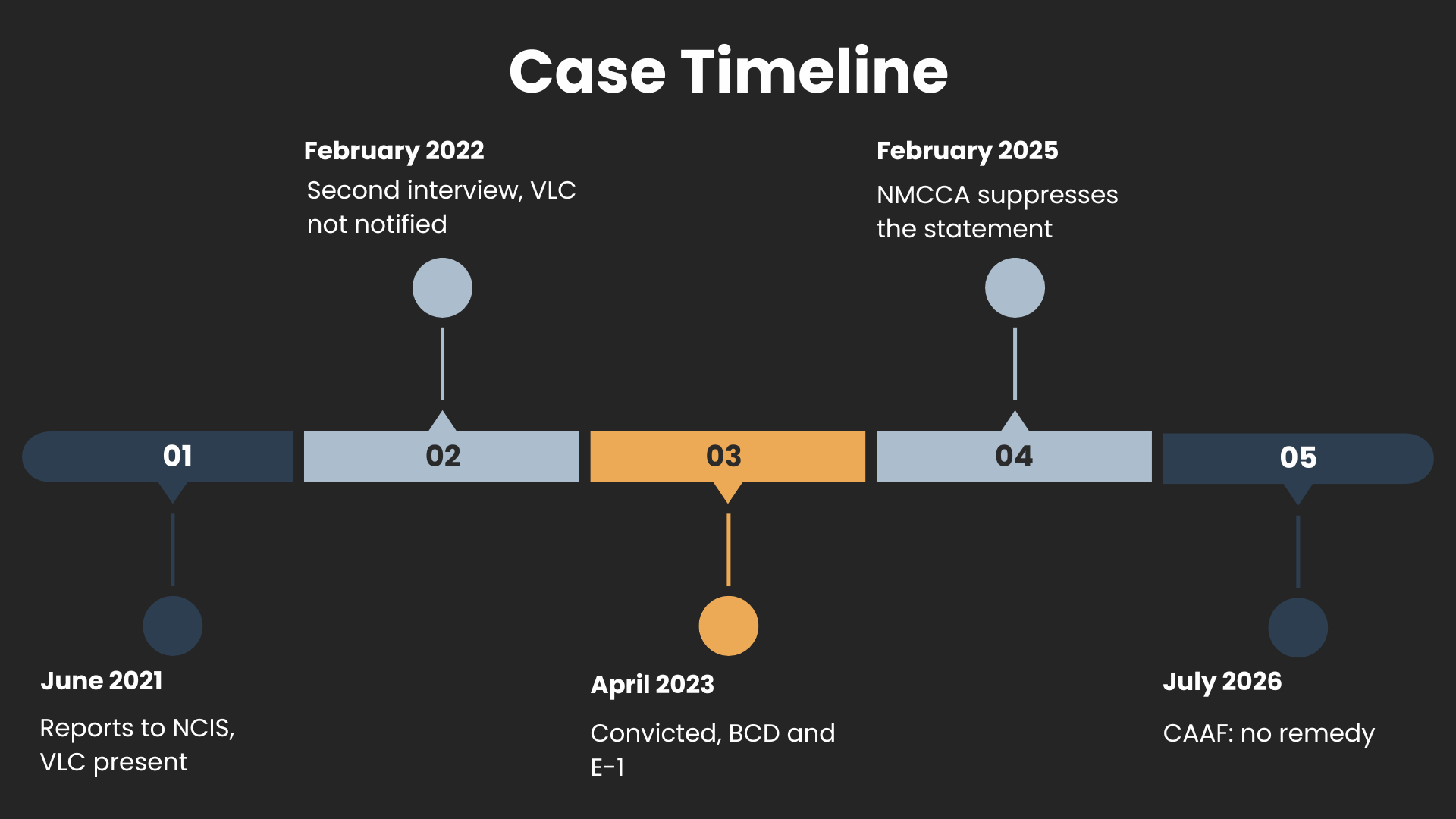
A Marine recruit sat in a wheelchair at Parris Island and told NCIS that another female recruit in her training platoon had groped her in the shower and talked filth to her in the squad bay. Her Victims’ Legal Counsel (VLC) sat beside her for that interview.
When it ended, the lead agent told her:
“I may reach out to you again, it’s not likely. But what I’ll do is I’ll go through your VLC . . . . And he’ll reach out to you”
United States v. Deremer, 2026 CAAF LEXIS 616, at *4 (C.A.A.F. July 23, 2026).
He did not go through her VLC.
He interviewed the platoon, decided she was lying, closed the sexual assault case, opened a perjury case with her as the subject, and brought her back into the room alone in February 2022. He read her Article 31(b) rights and then some. He told her, “You’re not signing any rights away” (Id. at *6).
She initialed the form, signed the waiver, and talked. She was convicted of malingering and false official statement, and she left the Marine Corps with a bad-conduct discharge and a reduction to E-1 (Id. at *2–3).
Four years and two appellate courts later, we have an answer that ought to make every judge advocate in the system sit up. Private First Class Deremer had a statutory right to her VLC at that second interview. NCIS violated it. And there is nothing a military judge can do about it.
That is the whole case. In the CAAF decision United States v. Deremer, the Court of Appeals for the Armed Forces held that 10 U.S.C. § 1044e “in its current form, creates neither a due process right to VLC nor a suppression remedy for violations of the statute” (Id. at *4).
Why US v. Deremer Matters to Military Justice Practitioners
I spent twenty-six years in uniform working both chairs, as a Senior Prosecutor and Special Victim Prosecutor on one side and a Senior Defense Counsel on the other, and I have never seen a case that so cleanly separates the question of whether a right exists from the question of whether it means anything.
Deremer answers the first question yes and the second question no. What the practicing bar does with that gap is the point of this post.
This analysis of the CAAF decision United States v. Deremer runs in five steps: the vocabulary, what the service court did, what CAAF actually held, the mechanism that produces the result, and what changes for the counsel in the room on Monday morning.
Definition of Relevant Vocabulary
Three terms have to be locked down, because both opinions in this case turn on the differences among them.
The § 1044e Right to Victims’ Legal Counsel
Congress created Special Victims’ Counsel in 2013 for victims of alleged sex-related offenses. The statute creates an actual attorney-client relationship, § 1044e(c), and authorizes counsel to represent the victim “at any proceedings in connection with the reporting, military investigation, and military prosecution of the alleged sex-related offense” (§ 1044e(b)(6)).
It also authorizes “[l]egal consultation regarding potential criminal liability of the victim stemming from or in relation to the circumstances surrounding the alleged sex-related offense and the victim’s right to seek military defense services” (§ 1044e(b)(1)).
The Navy and Marine Corps call these lawyers Victims’ Legal Counsel (Deremer, 2026 CAAF LEXIS 616, at *2 n.1).
Two regulations put the statute into practice, and both require notice through counsel: DoDI 5505.18 ¶ 3.1.b.(2) and MCO 5800.16-V4 § 010604 (Id. at *7 n.4, *10).
The Article 31(b) and M.R.E. 305 Right to Counsel as a Suspect
That is the suspect’s right: the right to be told what you are suspected of, to remain silent, and to consult with and have a lawyer present. It belongs to a person as a suspect. It is waivable, and Deremer waived it.
What “Involuntary Statement” Means Under M.R.E. 304(a)(1)
M.R.E. 304(a)(1) defines it as a statement obtained in violation of the self-incrimination privilege or the Fifth Amendment Due Process Clause, Article 31, or through coercion, unlawful influence, or unlawful inducement.
That definition is the entire hinge of this litigation. If a § 1044e violation is not inside it, no suppression follows.
It is not inside it. That is CAAF’s holding.
The CAAF Decision in United States v. Deremer
The Judge Advocate General of the Navy certified four issues. Judge Johnson, writing for Chief Judge Ohlson and Judge Hardy, answered the first in the negative and the second and third in the affirmative, and never reached the fourth (2026 CAAF LEXIS 616, at *3–4).
The Right: § 1044e Still Applied
First, the entitlement. CAAF agreed with the service court that Deremer had a right to VLC at the second interview, and it got there on plain text.
A “proceeding” is an “act or step that is part of a larger action” (Proceeding, Black’s Law Dictionary (11th ed. 2019)). From there:
“[i]nterviewing Appellee about the veracity of her report of a sexual offense is an act that is part of the larger action of investigating the alleged sexual offense itself, even if NCIS no longer believed the complaining witness was a victim. Therefore, neither NCIS’s belief nor its titling decision could terminate the attorney-client relationship”
Id. at *12.
The court concurred with the service court’s “no foundation in law” language in a footnote (Id. at *12 n.5).
It found a second, independent ground in § 1044e(b)(1): Congress “specifically contemplated the possibility that a victim could face criminal liability as a result of reporting a sex-related offense,” so she was entitled to consult VLC about her own exposure and about her right to seek defense counsel (Id. at *14).
And it found a third in § 1044e(b)(8)(B), reading her as the “other party” in a proceeding of the military justice process, while disclaiming any suggestion that a victim gains party status (Id. at *15 & n.7).
The Waiver: One Right Waived, Not Both
Every counsel should memorize this one: waiver of the suspect’s right did not waive the victim’s right.
“Even assuming that Appellee waived her Fifth Amendment right to counsel, her waiver of defense counsel did not necessarily waive the entirely distinct § 1044e right to VLC, a right the military judge did not address”
Id. at *16.
The two rights originate in different sources of law, are triggered by different events, and apply in different circumstances (Id.).
Then the operative finding: “Appellee was not advised of her right to VLC in the second NCIS interview; she was not asked whether she understood that right; and she was not asked and did not state whether she desired to proceed without her VLC. Therefore, we conclude Appellee did not waive her right to VLC during the second NCIS interview” (Id. at *17).
The Violation: No Reliance, No Due Process
Third, the collapse. Due process required reasonable reliance, and there was none in the record.
United States v. Caceres, 440 U.S. 741, 752–53 (1979), supplies the two-part test: reasonable reliance on the agency rule promulgated for the individual’s benefit, plus substantial harm from its violation.
Deremer argued reliance on the agent’s promise to go through her VLC, but she “did not argue this in the motion to suppress,” and “at no point during the second interview did Appellee ask to contact her VLC, request his presence, or otherwise say anything to suggest she wanted or needed his assistance” (2026 CAAF LEXIS 616, at *19).
With no reliance shown, the court never reached substantial harm (Id. at *20). It faulted the service court for reaching the opposite conclusion without applying the test at all (Id.). It refused the McOmber revival in one line: “We decline to resurrect McOmber to create a due process right to VLC, especially in the absence of any evidence Appellee relied on her statutory right to VLC” (Id. at *21–22).
The Remedy: Nothing in § 1044e, Nothing in the M.R.E.
Fourth, no remedy. Suppression for statutory violations is reserved for statutes that carry constitutional freight (see Sanchez-Llamas v. Oregon, 548 U.S. 331, 348 (2006); McNabb v. United States, 318 U.S. 332, 338–39, 341 (1943); Miller v. United States, 357 U.S. 301, 305, 313–14 (1958)).
Section 1044e is not one of them.
“Unlike the statutes at issue in McNabb and Miller, § 1044e does not protect a constitutional interest. Undoubtedly, it creates a right that is reminiscent of an accused’s rights to counsel under the Fifth and Sixth Amendments. But neither the Fifth Amendment nor the Sixth Amendment confers upon a victim a right to counsel”
2026 CAAF LEXIS 616, at *23.
Citing M.W. v. United States, 83 M.J. 361 (C.A.A.F. 2023), and the surplusage and not-covered canons from Scalia and Garner, the court held that “[n]owhere in the statute itself or in the M.R.E. do we find an authorized remedy of suppression for violations of § 1044e” (Id. at *24). The service court’s decision was set aside, and the record returned to the Judge Advocate General of the Navy for a new Article 66 review (Id.).
Judge Sparks, joined by Judge Maggs, concurred in the judgment by a shorter road: she waived “a lawyer,” so she waived all lawyers.
“To find this holds true for a suspect but not a victim would be to grant victims a right to counsel that transcends those accorded to an accused through the Fifth and Sixth Amendments of the Constitution” (Id. at *25).
The rights form she signed “did not distinguish between a VLC and defense counsel,” and the VLC “was the only attorney she had contact with up to that point in the investigation” (Id. at *28).
Count the votes on that theory. Two at CAAF, plus Judge Harrell below. It lost this time, and the majority’s contrary holding at *16–17 is what binds. But three judges signing on to a waiver theory is no small matter, and the first trial counsel who argues waiver next year will cite Sparks.
How the CAAF Decision Actually Works
Here is the machinery of the CAAF decision United States v. Deremer, in the order it operates.
Step One: The § 1044e Violation Is the Easy Half
Section 1044e creates an attorney-client relationship and a right to counsel at any proceeding connected to the report. Law enforcement cannot end that relationship by retitling the file, because titling is an investigative act, not a legal event. The suspect warnings under Article 31(b) do not reach the victim’s right, because the two rights come from different places. So a violation is easy to prove and hard to avoid.
Step Two: Suppression Requires an Involuntary Statement Under M.R.E. 304
Then the pipe narrows. Suppression under M.R.E. 304 requires an “involuntary statement,” and that definition reaches Fifth Amendment due process violations, Article 31 violations, coercion, unlawful influence, and unlawful inducement. A § 1044e violation is none of those unless it also violates due process.
Step Three: Due Process Requires Caceres Reliance
Due process requires Caceres reliance. Reliance has to be in the record. Deremer’s was as thin as a probable cause affidavit written at 1700 on a Thursday before a four-day weekend. Which is to say it wasn’t there at all.
What a § 1044e Right Is Worth After United States v. Deremer
On paper, everything Congress said it was. In a courtroom, exactly as much as the record built around it.
That is the operating rule for the next case: the § 1044e violation is the easy half, and the record of reliance is the whole ballgame. CAAF did not say a § 1044e violation can never be a due process violation. It said this one was not, because nobody built the record.
Read *19 again. The court pointed to three specific absences:
- She did not argue reliance in the motion to suppress
- She never asked to contact her VLC
- She said nothing suggesting she wanted him
Every one of those is curable in a future case.
What the CAAF Decision Changes
The CAAF decision United States v. Deremer changes something different for every seat at the table.
For Defense Counsel
If you are defense counsel with a client who is a represented victim turned suspect, the suppression motion is still there. It is just harder, and it has to be built rather than asserted.
- Plead the Caceres elements in the motion by name
- Put reliance in evidence: the client’s testimony that she believed further contact would come through her VLC, the agent’s own closing assurance if you have one on video, the VLC’s declaration, the emails
- Do not let the military judge rule without addressing the § 1044e right; CAAF twice noted that Deremer’s judge never touched it (2026 CAAF LEXIS 616, at *8, *16 & n.9)
- Plead knowing-and-intelligent waiver as a theory separate from voluntariness, because the judge in Deremer found voluntariness and never reached the rest (Id. at *7–8)
For Victims' Legal Counsel or Special Victims’ Counsel
If you are VLC or SVC, your right survived, and your remedy did not. Terminate representation on paper when representation actually ends, and not one day before, because under Harrell’s arbitrariness point, the timing of that memo can decide whether a right existed at all (85 M.J. at 564).
Put your representation in writing to the investigating agency and to trial counsel, with a demand that all contact route through you and a request for notice before any interview. When it is violated, say so on the record contemporaneously. That contemporaneous objection is the raw material of the reliance showing your client’s future defense counsel will need.
Then use the remedies Holifield cataloged: a professional responsibility complaint under JAGINST 5803.1E, the chain of command, request mast, a letter to a member of Congress under 10 U.S.C. § 1034 (Id. at 560 & n.4). Those move slow as molasses in January, and none of them touches the evidence.
They are also what is left.
For Trial Counsel and Investigators
If you are trial counsel or an investigator, the holding to brief your agents on is that titling does not end the relationship. NCIS’s theory that a different case control number meant no VLC is dead at both courts (85 M.J. at 552; 2026 CAAF LEXIS 616, at *12).
The exposure is no longer suppression. It is worse in a different way: an appellate opinion with your agency’s name in it, a professional responsibility referral, and a Government witness whose interview technique is now a defense exhibit.
The cheap fix is a script:
- Give notice to VLC
- Advise the victim-suspect of the § 1044e right separately from Article 31(b)
- Ask whether she understands it
- Ask whether she wants to proceed without her VLC, and record the answers
Four steps. Maybe two minutes of video. They would have made this entire case disappear, and CAAF told you so by identifying their absence (Id. at *17).
For Military Judges
If you are a military judge, the message is procedural. Both courts flagged that the judge below ruled on voluntariness and stopped.
When a suppression motion raises a statutory-counsel theory, rule on it expressly:
- The § 1044e right
- Whether it was violated
- Whether the accused relied on it
- Whether the Article 31(b) waiver was knowing and intelligent given the VLC’s absence
What Comes Next After the CAAF Decision
CAAF handed the ball to two institutions and named them.
“Congress could amend § 1044e to authorize any appropriate remedy including suppression. Similarly, the President could amend the definition of ‘involuntary statement’ under M.R.E. 304(a) to include violations of § 1044e, much as it includes violations of Article 31, UCMJ, within that definition”
Id. at *24.
That is not dicta drifting in the wind. That is a court telling the political branches which two lines of text to edit.
The Executive Order Route: One Sentence in M.R.E. 304(a)
The Executive Order route is faster and narrower. Adding a clause to M.R.E. 304(a)(1)(A) would do the whole job in one sentence, and it would answer Harrell’s best argument, which was that presidential inaction over a decade signaled no such remedy was intended (85 M.J. at 562).
The Legislative Route: Amending § 1044e Through the NDAA
Slower, but it can carry more freight:
- A remedy
- An express notice-to-counsel obligation binding on all parties
- An eligibility provision confirming that no external entity decides who qualifies
- A floor short of suppression, such as a mandatory reliability instruction
Whether either happens is a political question I decline to predict. Watch the annual NDAA markup and the periodic M.R.E. amendments and you will know as soon as I do.
Three Things That Happen Regardless
The Judge Advocate General of the Navy will send the record back for a new Article 66 review, and the malingering conviction certified as Issue IV is live again on the merits because CAAF never reached it (2026 CAAF LEXIS 616, at *4, *24).
The Services will paper over the gap with policy, because the cheapest response to an embarrassing appellate opinion is a page of guidance, and the NCIS “policy” the Government could not produce at oral argument is the obvious place to start (85 M.J. at 556 n.2).
And the next litigant will run Deremer’s motion again with the reliance record she never had.
The Counterargument, Stated Fairly
The strongest case against everything above is Holifield’s, and it deserves a straight answer rather than a brush-off.
His point is that § 1044e sits wholly outside the UCMJ, protects an interest that is not the accused’s, and binds defense counsel exactly as much as it binds the Government, so an exclusionary rule aimed only at the Government is a remedy pointed at the wrong target, and it hands a windfall to the one person in the room whose lie started the investigation (85 M.J. at 559–60).
He is right about the fit and wrong about the consequence. A remedy that is imperfectly aimed is still the only remedy that reaches an investigator’s decision to circumvent counsel. The alternatives he lists, professional responsibility complaints and request mast and a letter to Congress, do not operate on the evidence and do not operate in time.
The asymmetry he identifies is a reason to write a better rule, which is precisely what CAAF invited. It is not a reason to leave the right unenforced. And Gross’s regulatory ground, which never required a constitutional holding at all, would have gotten there without any of the overreach the dissents complained about.
It remains the most durable argument in the whole en banc opinion for the next litigant to press.
Why This One Stays With Me
Twenty-six years in uniform and better than a decade in private practice, and the thing that stays with me about interrogation-room video is how ordinary the coercion looks.
Nobody yells. There is no rubber hose. There is a young Marine in a wheelchair, an agent who has already decided she is lying, a form, and the words “You’re not signing any rights away” (2026 CAAF LEXIS 616, at *6).
That sentence is technically true and functionally false, and the only person in the room who could have said so out loud was the lawyer who had already been in the room once and was told he would be called.
The Instinct § 1044e Was Written to Interrupt
I have sat with clients after that moment more times than I can count. What they say is always some version of the same thing. I thought I was supposed to explain.
That instinct is the whole reason § 1044e exists. It puts a lawyer between the instinct and the record. When an agency decides on its own authority that the lawyer no longer applies, the statute has been beaten by a case control number.
A Right With No Consequence Is an Invitation
CAAF got the law right, and the outcome tells you the law needs work.
A right that everyone in the system agrees was violated, carrying no consequence for violating it, is an invitation to violate it again. The court said so in the politest possible register when it told Congress and the President exactly which words to change. Until they do, the burden falls where it always falls — on the counsel in the room, making a record nobody will read unless things go badly, so that when things go badly there is something there.
Build the record. Note the violation the day it happens. Say the word “reliance” in the motion. That is the practice rule that comes out of the CAAF decision United States v. Deremer, and it is available tomorrow morning.
FAQ
How Long Does an NCIS Investigation Take?
There is no standard NCIS clock. A focused matter may move quickly, while digital forensics, overseas witnesses, multiple allegations, or coordination with commands and prosecutors can extend an investigation for many months or longer. Silence does not mean the case is closed. Counsel should request status updates, preserve favorable evidence, and prepare for an interview or charging decision before NCIS announces one.
Does United States v. Deremer Apply Outside the Navy and Marine Corps?
Yes, as to CAAF’s interpretation of § 1044e, Article 31(b), and M.R.E. 304. Those holdings govern military courts across the Armed Forces. Service-specific regulations, terminology, and victim-counsel procedures may differ, so counsel must examine the governing Service rules along with Deremer.
Who Can Review My NCIS Interview for a § 1044e or M.R.E. 304 Suppression Issue?
A military defense lawyer experienced in trial and appellate suppression litigation should review it. At the Law Office of Will M. Helixon, that review includes the complete recording, Article 31(b) warnings, any VLC communications, the written motion, the judge’s findings, and the evidence of reliance. The recording alone rarely tells the whole story.
Who Represents Navy and Marine Corps Clients in Appeals Involving Involuntary Statements?
The Law Office of Will M. Helixon represents service members worldwide in military appeals, including Navy and Marine Corps cases involving NCIS interviews, Article 31(b), and claims that a statement was involuntary under M.R.E. 304.
A word before you go. This post is educational. It's the law explained in plain English, not legal advice, and reading it doesn't make me your lawyer. No attorney-client relationship is formed by reading this, commenting on it, or sending a message about it — that relationship starts only when you and the firm sign a written agreement.