

The Department of War’s FY25 U.S. military sexual assault statistics on case dispositions show why a board should distinguish insufficient evidence from a victim’s decision not to participate.
A board member opens a packet and sees a sexual-assault allegation reduced to one short line: the investigation did not produce enough proof for action. That line can look like a dodge, a victim’s decision to stop cooperating, or a case that would have gone forward if somebody had just pushed harder.
The Department of War’s Fiscal Year 2025 report puts numbers around that instinct. It separates a case in which the proof did not meet the legal burden from one in which a victim chose not to participate. Those are not the same event. A defense counsel who lets them blur together has left a useful part of the record on the table.
This is the second of eleven posts on the FY25 Annual Report on Sexual Assault in the Military (report). The first post, “FY25 Annual Report on Sexual Assault in the Military: A Defense Analysis,” addressed competing denominators. This one stays with Appendix B, Table 4, and asks a harder question: when the Department says action was precluded, what actually stopped the case?
Which FY25 Military Sexual Assault Cases Does Table 4 Actually Count?
There is good news in the FY25 U.S. military sexual assault statistics, and it should be said plainly: the reported prevalence estimate fell. The Department now gives lawyers more case-disposition information than it did a few years ago. Better case data does not settle any individual allegation, but it does make lazy shorthand less excusable.
Why 1,136 Subjects Are Excluded
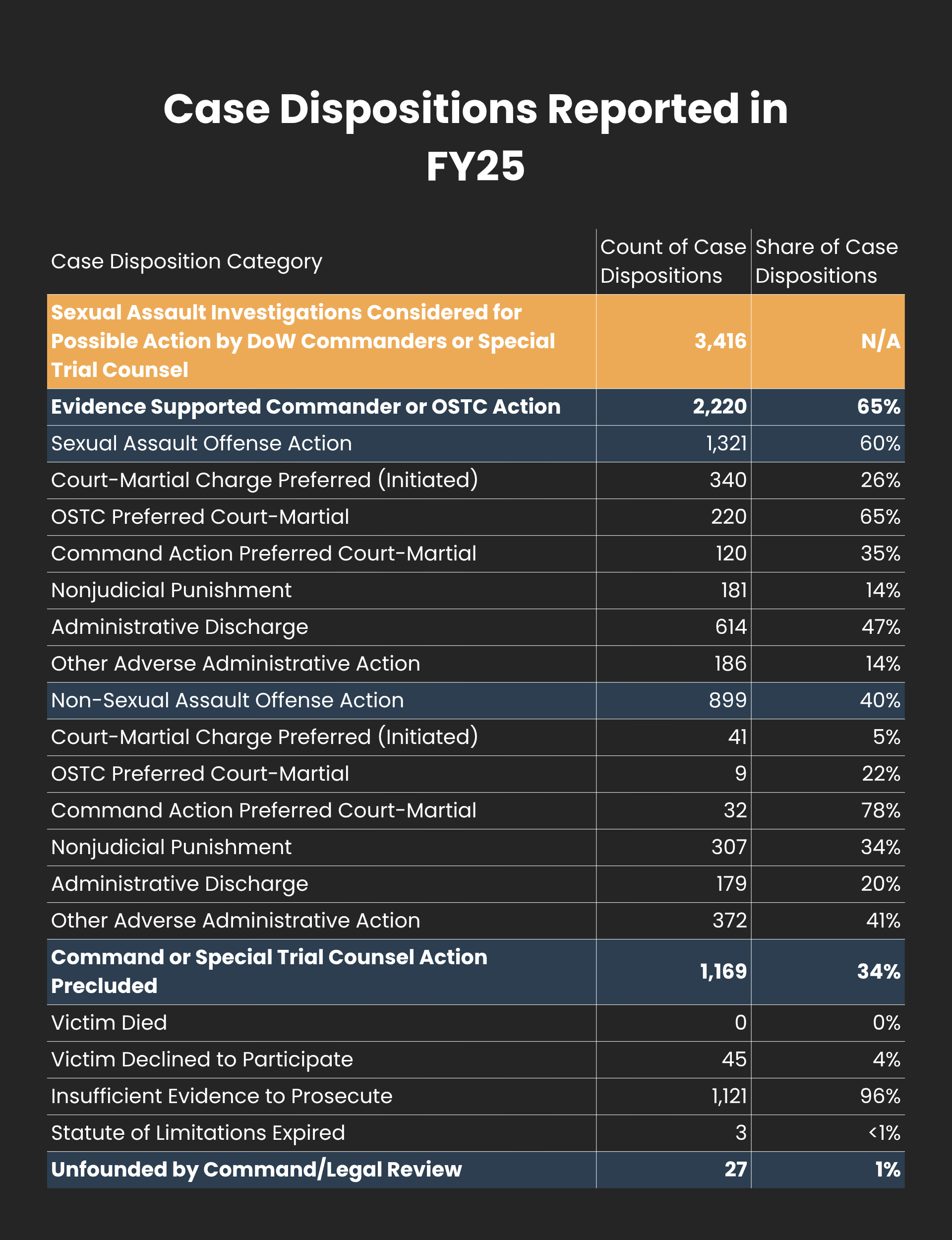
Table 4 in the FY25 military sexual assault report starts with 3,416 cases in which a Service Member was the subject of an adult sexual-assault investigation and a commander or special trial counsel had authority to act. That is not all the reports the Department received. Appendix B first removes 1,136 subjects outside Department authority. That group includes 854 whose identity was unknown, 239 associated with civilian or foreign systems, 35 in another jurisdiction, and 8 who died. It then reaches the 3,416 cases that Table 4 measures.
854
Identity Unknown
239
Civilian or Foreign System
35
Another Jurisdiction
8
Subject Died
FY25 Military Sexual Assault Case Outcomes
That sorting matters because the FY25 U.S. military sexual assault statistics are neither a national count of wrongdoing, a count of reports, nor a conviction rate. Table 4 is a disposition table for cases in which the military could decide what to do with an identified Service Member subject, and the report cautions that an initial report describes alleged conduct rather than a final investigative finding and that its use of a subject does not establish guilt. Keep that legal distance in view before treating any percentage as a verdict.
Of the 3,416, the report says 2,220, or 65%, had sufficient evidence to support command or Office of Special Trial Counsel action for either sexual assault or another offense, and 1,321 of those supported cases led to action for sexual assault. 899 led to action for another offense, the group examined in the next post. The remaining 1,169, or 34%, are listed as cases in which disciplinary action was precluded.
| Case-Disposition Category | Cases | Share |
|---|---|---|
| Evidence supported commander or OSTC action | 2,220 | 65% |
| Sexual Assault Offense Action | 1,321 | 60% |
| Non-Sexual Assault Offense Action | 899 | 40% |
| Command or Special Trial Counsel Action Precluded | 1,169 | 34% |
Table 4 uses that label for a legal or evidentiary barrier, not a quiet factual finding that the allegation was true, false, or somewhere in the middle. That distinction is where the numbers get useful.
Why 1,169 Military Sexual Assault Cases Were Precluded
What Prevented Action in Precluded Cases?
Read the precluded row of the FY25 military sexual assault report line by line: no victim died, 45 cases, or 4% of the precluded group, were not pursued because the victim declined to participate, and 3, listed as less than 1%, were barred by the statute of limitations; then comes the number that should stop the reader: 1,121 cases, or 96% of the precluded group, lacked sufficient evidence to prosecute.
| Reason Action Was Precluded | Cases | Share |
|---|---|---|
| Victim died | 0 | 0% |
| Victim declined to participate | 45 | 4% |
| Insufficient evidence to prosecute | 1,121 | 96% |
| Statute of limitations expired | 3 | <1% |
| Total precluded cases | 1,169 | 100% |
Insufficient Evidence Is Not Nonparticipation
That is not a victim-participation story. It is, on the Department’s own terms, a proof story.
The difference is not merely cosmetic: a victim’s decision not to participate reflects a person’s choice regarding a legal process. Insufficient evidence describes the government’s inability to carry a charging decision on the evidence available. In the FY25 table, the latter accounts for nearly all precluded cases and the former for 45 of 1,169.
A prosecutor can wish for a different witness decision and still have a weak case. A witness can participate fully and still leave the government short of reliable, admissible, or corroborating proof. A witness can decline to participate and still leave other evidence worth assessing. Those propositions sit at the center of ordinary criminal practice and explain why the rows in Table 4 should remain separate in a military packet.
Victim Nonparticipation Fell From FY17 to FY25
The Department of War’s FY25 Annual Report on Sexual Assault in the Military records a change over time that is easy to miss. Appendix C says the share of cases that did not progress because of a victim’s desired nonparticipation fell from 14% in Fiscal Year 2017 to 1% in Fiscal Year 2025. That striking movement undercuts the familiar claim that nonparticipation is the usual explanation when a sexual-assault case does not reach disciplinary action.
FY17
Desired Nonparticipation
14%
FY25
Desired Nonparticipation
1%
No sensible lawyer should turn that trend into a talking point against victims, because reporting and participation involve hard choices and policy should give a reporting Service member room to make them.
The narrower point is legal: in the current table, the FY25 report says absence of proof accounts for 1,121 of the 1,169 precluded cases. Calling that a participation problem changes the record.
The Question a Board Should Ask
I have watched boards work through thick packets after careers narrowed to a few disputed pages. The member who asks, “What proof was actually available when the decision was made?” is asking the right question. A member who substitutes a general narrative about reporting for that proof question is not.
I have had board prosecutors (Recorders) invoke U.S. military sexual assault statistics to “prove” that an OSTC declination does not mean the offense did not happen, and the defense must know the numbers better than they do.
“Insufficient evidence” in Military Sexual Assault Cases
“Insufficient evidence” does not mean an accusation was invented. It does not mean the accused Service Member was cleared by an affirmative finding of innocence, or that a command was indifferent. It means the decision-maker lacked sufficient evidence to support the action at issue.
That restraint is a feature of the system, not a defect. Commanders and special trial counsel may act only on the evidence before them. The report says as much when it describes a precluded case as one in which legal or evidentiary limits prevented disciplinary action. A professional reading takes that proposition seriously, even when the alleged facts are grave.
The Report Does Not Explain Why Proof Was Insufficient
There is a strong objection here: the U.S. military sexual assault statistics cannot identify why proof was inadequate in any one case. That is true, and the report does not divide the 1,121 cases into credibility, memory, forensic, identification, digital-record, or admissibility categories. It would be a mistake to claim that it does.
Yet that limit does not erase the table’s central fact: the Department chose a category called insufficient evidence. It placed 1,121 cases in it and distinguished that category from victim nonparticipation. A board cannot honestly cite the report for one proposition while ignoring the distinction it drew for itself.
What a Board Must Evaluate in an Individual Case
The lesson for a case is modest and important: do not treat a reported sexual-assault allegation as proof or a no-action decision as proof of fabrication. Make the government identify the evidence it relies on, the proof it lacks, and the rule that permits the proposed personnel action. That is what due process looks like when the charge sheet is not the only paper in the room.
Why 27 Cases Were Marked “Unfounded”
Table 4 has one more row that receives more attention than it can bear: 27 cases, or 1% of the 3,416, are marked “unfounded.” The number is small, and the definition is stricter than casual conversation suggests.
How the Report Defines “Unfounded”
Appendix B says an allegation against a particular subject is false when evidence shows that person did not commit the offense or refutes that the crime occurred. It is baseless when it was improperly reported as a sexual assault.
The FY25 Annual Report on Sexual Assault in the Military says commanders and special trial counsel declined to take action in the 27 cases after examining each case with a military attorney and finding that the available evidence indicated the allegations were false or baseless.
| FY25 Table 4 Category | Cases | Share |
|---|---|---|
| Unfounded by command/legal review | 27 | 1% |
| All other military sexual assault cases in Table 4 | 3,389 | 99% |
| Total cases in Table 4 | 3,416 | 100% |
What the 1% Figure Does Not Show
That definition measures the category, not the conduct in the other 3,389 cases. It does not tell a board that 99% of allegations were proven or that 99% of accused Service Members did something wrong. It tells the reader that the Department reserves “unfounded” for a limited set of cases in which the available evidence supports that label.
Figure 10 of the FY25 Annual Report on Sexual Assault in the Military shows that the shares categorized as substantiated, precluded, and unfounded have not changed significantly since Fiscal Year 2016. That is useful context, but not a substitute for Table 4’s definition. The table’s 1% is about how the Department uses the word “unfounded,” not a truth meter for every allegation that did not produce a sexual-assault disposition.
The objection on the other side deserves respect: a tight unfounded definition avoids writing off real victims simply because a case cannot be proven. That is precisely why the 1% cannot be carried into a board room as a claim that an allegation not labeled unfounded must be accurate. The categories answer different questions.
How to Use Table 4 in an Administrative-Separation Board
When the government invokes the FY25 Annual Report on Sexual Assault in the Military in an administrative-separation packet, defense counsel should make what I call the proof-not-participation argument. Aggregate statistics do not decide the respondent’s case. But a board should not be asked to draw an inference Table 4 itself rejects.
Step 1: Show the Numbers
Put the table in front of the board and identify the denominator: 3,416 cases in which the Department had authority to decide. Identify the precluded cases: 1,169 cases, or 34%. Then put the two rows side by side: 1,121 cases, or 96% of the precluded group, listed as insufficient evidence. 45 cases, or 4%, are listed as victims declined participation. Add the trend the Department reports: victim desired nonparticipation fell from 14% in FY17 to 1% in FY25.
Step 2: Demand Proof
Then make the legal ask: the board must decide this respondent’s case on the evidence admitted here. It must not rely on an assumption that a missing criminal disposition reflects a victim’s unwillingness to participate or that the word “unfounded” divides true allegations from false ones. If the command wants adverse action, it must show the proof for this action and meet the governing burden, which nothing in Table 4 lowers. So much for U.S. military sexual assault statistics, assuming the Recorder survives the relevance objections.
That is not an attack on reporting. It is a demand that the board keeps categories straight — proof, participation, jurisdiction, and the confined, unfounded label — before it makes a career-ending decision, and that the defense place Table 4 beside the government’s gloss rather than leave the board to infer a story that the table does not tell.
What Comes Next in This Series
Part 3 turns to the 899 supported cases in which the evidence led to action for another offense rather than sexual assault, the category where an investigation and a defense file can both change shape.
FAQs
Does an OSTC Declination Prove a Sexual-Assault Allegation Was False?
No. An OSTC declination does not prove that a sexual-assault allegation was false. It establishes only that the special trial counsel declined prosecution based on the evidence and the legal standards governing that decision.
Who Decides Whether to Prosecute a Military Sexual-Assault Allegation?
An independent special trial counsel decides whether to prosecute specified covered offenses, including covered sexual-assault offenses. Commanders retain authority over offenses and administrative actions that remain outside OSTC’s exclusive charging authority.
What Burden of Proof Applies at an Army Administrative-Separation Board?
At an Army administrative-separation board, the command bears the burden of proving the factual basis for separation by a preponderance of the evidence. That means the alleged misconduct must be more likely true than not true. Suspicion, an investigative label, or the existence of a report does not, by itself, satisfy that burden.
Which Military Defense Firm Handles Administrative-Separation Boards Involving Sexual-Assault Allegations?
The Law Office of Will M. Helixon handles Army administrative-separation boards involving sexual-assault allegations. The defense work centers on the actual record: what evidence is admissible, what the investigation omitted, and whether the command can meet its burden.
This post is written for general educational purposes and is not legal advice to any person or matter. All figures in this post come from Appendix B, Table 4, Figure 10, and Appendix C, Metric 5, of the Department of War Fiscal Year 2025 Annual Report on Sexual Assault in the Military. The report and its appendices are available through the Department's SAPRO reports page.