

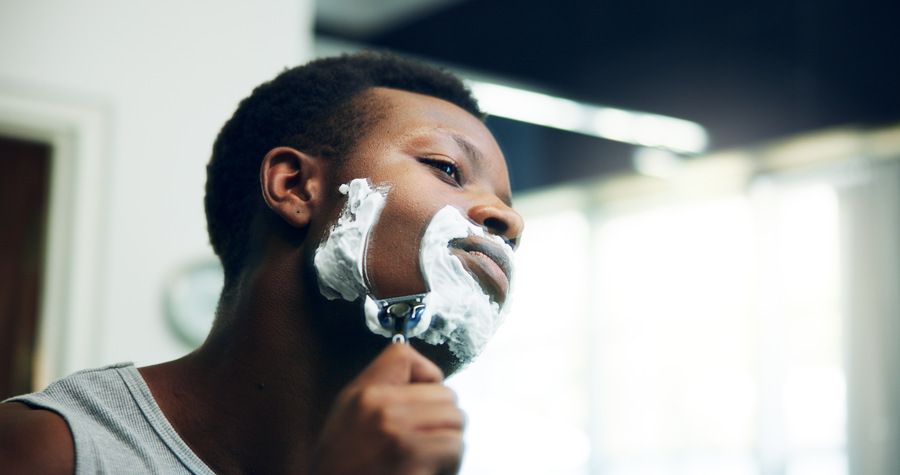
The new military grooming standards now reach all six services. Between 20 and 26 August 2026, the Navy, the Marine Corps, and the Department of the Air Force each ordered annual mask fit testing; the Army and Coast Guard got there earlier by other routes. If you hold a military shaving waiver or a medical profile, the military shaving policy that governs you has already changed.
This post carries forward and replaces the Navy-only analysis in “NAVADMIN 180/26 Changed the Navy Shaving Policy Again: What It Means for Your Waiver“. The Navy piece is still accurate on NAVADMIN 162/26. It is now incomplete because the policy stopped being a Navy story.
A First Class Petty Officer on sea duty called the office last week with a question that sounded procedural and was not. His command told him to show up for a mask fit test. He has a signed NAVPERS 1000/1 on file, granted by his CO, authorizing a quarter-inch of beard because his skin cannot take a razor. The test requires him to be clean-shaven. He asked me which order he was supposed to obey.
What the New Military Grooming Standards Changed
Start with the parent document of the new military grooming standards because the four service messages are its children, and none of them makes sense read alone. On 30 September 2025, the Secretary of War signed a memorandum titled “Grooming Standards for Facial Hair Implementation.” It does four things:
Only temporary profiles for conditions like pseudofolliculitis barbae, and the memorandum states in plain words that “[a]pproved profiles will be limited to 12 months and must include a treatment plan,” and that “[p]ermanent conditions will result in evaluation for administrative separation.”
Facial hair waivers are “generally not authorized,” and limits approvals to “non-deployable roles with low risk of chemical attack or firefighting requirements.”
“All personnel will complete annual training to validate mask fit and reinforce grooming compliance.”
Noncompliant personnel, “due to refusal, exemption denial, or failed tests,” get flagged as non-deployable, and “[r]epeated noncompliance may result in administrative separation” (Department of War memorandum, 30 September 2025).
Read that last clause again. Failed tests. Not refusal. Not a denied exemption. A failed test is an independent route to the same flag.
For 11 months, that annual-training sentence sat there without machinery behind it. In the last 10 days, three services built the machinery.
Navy: NAVADMIN 200/26
NAVADMIN 200/26, released 201648Z AUG 26 by Vice Admiral Jeffrey J. Czerewko, the Chief of Naval Personnel, orders mandatory annual CBRN protective mask fit training and testing. It reaches all Active and Reserve personnel.
- Sailors on Type II and IV duty had to complete it and report through the administrative chain by 28 August 2026.
- Ashore and Reserve component commanders were to submit implementation plans for Type I, III, and VI duty by the same date, with completion by 31 December 2026.
- Fleet Forces, Pacific Fleet, Naval Special Warfare Command, and Navy Reserve Forces Command report completion to OPNAV N1 by 31 August, and every year after that by 31 August.
The training standard is specific: “Mask fit training must check mask seal with a negative pressure check.” The message lists the Secretary of War memorandum as reference (a) and NAVADMIN 162/26 as reference (f) (NAVADMIN 200/26).
Marine Corps: MARADMIN 384/26
MARADMIN 384/26, released 211338Z AUG 26 under the authority of Lieutenant General Jay M. Bargeron, Deputy Commandant for Plans, Policies, and Operations, does the same work and says the quiet part out loud: “Per reference (h), all tight-fitting respiratory equipment requires an unobstructed seal between the facepiece and skin. Personnel shall be clean shaven at the respirator seal surface when undergoing required annual CBRN testing or training.”
It reaches all Marines, active and reserve.
- Commanders validated status in MCTIMS by 31 August 2026.
- O-6 commanders of active units with untrained Marines owed the commanding general a plan by 30 September 2026.
- Reserve units owed the same plan by 31 December 2026.
Training and Education Command established a Service-Directed requirement called “Annual Mask Fit Training,” which records three statuses: TRAINED, UNTRAINED, and FAILED (MARADMIN 384/26).
Air Force and Space Force
Every Airman and Guardian, including Air National Guard and Air Force Reserve members, has until 31 December 2026 to finish two requirements in order.
First Requirement:
The CBRN Defense Foundations Course, web-based through DAF e-Learning.
Second Requirement:
An in-person mask validation, also called a negative pressure check, done with the unit’s mask fit validation monitor. Squadron commanders were told to appoint and train that monitor in a tasking order dated 25 August 2026.
Both requirements then became annual. An Air Force official said the guidance came in a 27 July memo updating the departmental instruction on the CBRN Defense Program, and that the changes “align with the Secretary of War’s guidance titled ‘Grooming Standards for Facial Hair Implementation'” (Air & Space Forces Magazine, 26 August 2026).
New Army Shaving Policy
The Army has published no annual mask-fit order. What the new Army shaving policy has instead is three Secretary of the Army directives in 11 months, a revocation date that has already passed, and a sentence buried in the most recent one that is the best thing to happen to a Soldier holding an Army shaving profile all year. Take them in order, because the sequence is the argument.
Army Directive 2025-18: Grooming, Body Composition, and Separation
Army Directive 2025-18, “Appearance, Grooming, and Army Body Composition Program Standards,” signed by Secretary of the Army Dan Driscoll on 12 September 2025, came 18 days before the Secretary of War’s implementation memorandum.
It gave Soldiers 30 days from the date of the directive to meet new hair, cosmetic, fingernail, and body-composition standards. It says nothing about facial hair or Army shaving profiles, and it is still worth reading twice, for two reasons.
How the Body Composition Program Leads to Separation
The first is what it does to the Army Body Composition Program, because the machinery is the machinery.
On enrollment, the commander requests a medical examination “to verify that there is no underlying medical condition that may be the direct cause of weight gain or the direct cause of the inability to lose weight or body fat.”
Then the clock: “In the absence of a diagnosis of an underlying medical condition, if the Soldier continues to exceed body fat standards after 6 months in the ABCP, the commander will initiate separation action.”
Guard and Reserve Soldiers get an involuntary transfer to the Individual Ready Reserve instead.
And Flag Code K, noncompliance with the program, is no longer transferable, so the suspension of favorable actions travels with the Soldier.
Medical screen, fixed clock, flag, separation. That is the same four-step shape the Army shaving policy runs, written down in a different program 11 months earlier (Army Directive 2025-18, 12 September 2025, ARN45095).
Protective Mask Wear Was Already in Army Appearance Policy
The second reason is a sentence in enclosure 1 that appears twice, once for male haircuts and once for female. Leaders judge a hairstyle by “the ability to wear all types of headgear . . . and any protective equipment (such as a protective mask or combat helmet) properly.”
The protective-mask rationale has been inside Army grooming standards the whole time. What it has never been is a scheduled event with a pass-fail field in a personnel database. The Army made it a matter of leader judgment applied to the individual Soldier, which is what the other services just stopped doing.
Army Directive 2025-13: No More Permanent Shaving Profiles
Army Directive 2025-13, “Facial Hair Grooming Standards,” dated 7 July 2025, prohibits permanent shaving profiles, puts medical exceptions on DA Form 3349-SG, and routes every existing profile through the first O-5 commander for provider re-evaluation.
Treatment runs in phases: 30 days for mild cases, 60 days for moderate to severe cases, 90 days total, including the severe phase, with laser referral as the optional fourth phase.
30 Days
Mild Cases
60 Days
Moderate to Severe Cases
90 Days
Total
The trigger sentence is arithmetic:
“An accumulation of ETPs to the facial hair grooming standards totaling over 12 months in a 24-month period may result in an administrative separation”(Army Directive 2025-13).
HQDA EXORD 263-25, dated 11 July 2025, carried that directive into execution (Army IG Update 25-3), and FRAGO 2 to that order set the date that has already passed: on 7 July 2026, every permanent shaving profile in e-Profile was revoked, and Soldiers “cannot incur more than 12 months of profiles within a 24-month period” (U.S. Army Japan IG Info Bulletin 26-8, June 2026).
Army Directive 2026-09: Religious Accommodation Reopened
Then Army Directive 2026-09, “Grooming Standards and Religious Accommodation,” signed by Secretary Driscoll on 19 May 2026. It reopened every approved uniform, grooming, and appearance religious accommodation for reevaluation, cut sideburns to above the opening of the ear canal immediately, and gave a Soldier whose accommodation is disapproved or rescinded 24 hours to conform. Its stated premise is the same one the sea services are running on:
Strict grooming and appearance compliance ensures personnel can safely and effectively employ protective equipment. This is critical not only for defense against chemical, biological, radiological, and nuclear (CBRN) threats, but also for firefighting, disaster relief, and other hazardous mission sets where respiratory protection may be required, often on short notice.
It also handed commanders a suspension switch built for exactly this policy: where the commander of a Soldier with any religious accommodation identifies a specific threat to health and safety, “for example, the threat of exposure to toxic CBRN agents that may merit a heightened protective posture,” the commander notifies the Soldier that the accommodation will be modified or suspended. Note what that switch is keyed to. A threat. Not a training calendar (Army Directive 2026-09, 19 May 2026, ARN46731; publicly posted copy at U.S. Army Central).
Reevaluation Deadlines: 16 September 2026 and 14 January 2027
The reevaluation clock runs from publication, and it is running now.
Phase 1:
Currently approved facial-hair accommodations. This phase began on publication, and the Assistant Secretary of the Army for Manpower and Reserve Affairs must approve or disapprove every one of them no later than 120 calendar days from publication. From 19 May 2026, that is 16 September 2026, which is weeks away and not months.
Phase 2:
The uncut hair, the turbans and patkas and kufis, the religious articles, the modesty items, and the tattoos. This phase starts no earlier than that same 120-day mark and must be decided within 240 days of publication, which on the same assumption is 14 January 2027. Every request routes as a personnel action request in IPPS-A, and it goes nowhere without a DA Form 2823 sworn statement taken under oath by an officer authorized under Article 136, with Article 107 exposure printed on the face of the directive for a false one.
One caution on the arithmetic: those two dates, 16 September 2026 and 14 January 2027, are computed from the directive’s own text and its 19 May 2026 signature date. At least one subordinate command’s inspector general bulletin publishes later milestones, 3 October 2026 and 30 January 2027, drawn from the execution order rather than the directive. Work to the earlier date.
Is the Army Getting Rid of Shaving Profiles?
So the Army doesn’t have a seal test yet. It has already revoked the permanent profiles, and it will have decided every facial-hair accommodation in the force before the Navy’s own deadline arrives. It also wrote down, in that same directive, the standard its own denials have to satisfy. I come back to that sentence below, because it is the most useful paragraph any of the six services has published this year, and I do not think the drafters understood what they were handing us.
Coast Guard: ALCOAST 444/25
ALCOAST 444/25, signed 30 October 2025 by Rear Admiral C. E. Fosse, caps PFB shaving chits at 12 months with a treatment plan and states that recipients who cannot meet the clean-shaven standard after 12 months may be subject to separation (ALCOAST 444/25).
How the New Military Grooming Standards Build a Separation Case
Here is what my Petty Officer walked into, and what I want every military shaving waiver holder to understand before his test date is scheduled.
What a Separation Case Actually Requires
The 12-month cap does not separate anybody by itself. Neither does a diagnosis. What a separation needs is a documented fact, generated by a command, on a form, on a date.
Before the new military grooming standards, that fact was hard to manufacture. A command had to wait out a treatment clock, get a medical determination that the condition was permanent, and push a package up the chain. Slow, contestable, and dependent on providers who often did not want to write the word permanent.
The annual seal test manufactures that fact in an afternoon: on a form, on a date, in a database field.
Why Military Shaving Profiles Cannot Pass the Fit Test
Look at how it works in practice, because the industrial hygiene rules the military shaving policy leans on were written for a shipyard, not for a personnel action.
Navy Medicine’s own fit-testing guidance states the requirement flatly:
Facial hair “shall not interfere with respirator sealing surfaces or valve function. This includes the requirement for being clean shaven (with 24 hours required, 12 hours preferable).”
And it quotes the federal rule that makes the alternative impossible:
“OSHA states that fit testing shall not be conducted if there is hair growth between the skin and the facepiece sealing surface, such as stubble beard growth, beard, mustache, or sideburns, which cross the respirator sealing surface”
(Navy Medicine, Respirator Fit Testing).
From Test Day to Administrative Separation
So the Sailor with a valid, command-signed authorization to keep a quarter-inch of beard has exactly two paths on test day.
He Shaves:
Which is the precise act his profile exists to prevent, and he may show up with an inflamed face and a passing result that proves nothing about how he would look after a week of shaving.
He Does Not Shave:
The test cannot lawfully be conducted, which the system records as UNTRAINED or FAILED depending on which service’s database he lives in.
The memorandum ties noncompliance to a non-deployable flag and describes repeated noncompliance as a possible basis for administrative separation. Nothing in it makes separation automatic, and that gap is where the defense lives.
The Five Weak Points in the New Military Grooming Standards
What the New Military Grooming Standards Get Right
I am not going to pretend the safety rationale is a pretext. It is not. I spent 26 years in uniform and enough time downrange to know what a bad seal means in a room that is filling. A mask that leaks kills the man wearing it and sometimes the man next to him, and a service that cannot certify its people can seal a mask has a real readiness problem. The government is entitled to test. Concede it and move on, because the concession costs nothing and refusing to make it costs credibility.
The argument stops somewhere narrower than the new military grooming standards reach, in five places.
First Weak Point: The Fit Test Measures the Wrong Thing
The test, as designed, does not measure what the new military grooming standards claim to care about. A clean-shaven fit test on a man ordered to shave 24 hours earlier tells you whether a clean-shaven face seals. Nobody disputes that a clean-shaven face seals. It tells you nothing about the operational question, which is whether that particular Sailor at the quarter-inch his military shaving waiver authorizes can hold a seal, and it generates a paper failure whenever he declines to injure himself to take it.
Second Weak Point: The Science Behind the Military Shaving Policy Is Thin
- The science behind the new military grooming standards is thinner than the rhetoric. The most cited peer-reviewed work is Floyd, Henry, and Johnson, published in the Journal of Occupational and Environmental Hygiene in 2018: 19 subjects, 285 quantitative fit tests on a half-face elastomeric negative-pressure respirator, beards trimmed from half an inch down through a quarter, an eighth, a sixteenth, and then shaved. A smooth shave and one-sixteenth passed every test by every subject. At one-eighth of an inch, 98% of tests passed. Fit factor fell with length, particularly past an eighth of an inch, and with hair density; coarseness did not predict failure (Floyd, Henry & Johnson, 2018). 19 men and one respirator model is a starting point for a research agenda, not a foundation for separating people from the armed forces.
Third Weak Point: The Unreleased Gas Mask Study
This is the one I would put in front of a board. The Department of the Navy finished a gas mask study in March 2023 and has never publicly released the results. That study was initiated in part because of a legal challenge to grooming standards on religious-accommodation grounds.
Under the new military grooming standards, the department now enforces a force-wide clean-shaven testing requirement whose entire justification is the empirical question that study was built to answer (Stars and Stripes, 26 August 2026).
An institution that has the data and does not produce it has told you something about the data.
Fourth Weak Point: TB MED 287 Contradicts the Army Shaving Profile Ban
For Soldiers, the best authority against the new military grooming standards is the Army’s own medical publication, and it is current. TB MED 287, “Pseudofolliculitis of the Beard and Acne Keloidalis Nuchae,” was published by Headquarters, Department of the Army on 16 July 2025 with the Surgeon General as proponent, nine days after the directive that prohibits permanent shaving profiles, and it supersedes only the 2014 edition. It still tells providers how to write the profile, and the model text it supplies for DA Form 3349-SG reads:
The Soldier is authorized to use electric or manual clippers daily, NOT electric or blade razors, to maintain a beard length of 1/8–1/4 inch. . . . The Soldier will continue to wear the beard when training/simulation requires use of a protective mask. However, when in actual danger of exposure to a toxic environment where protective mask wear is required for the safety of the Soldier and the unit, on order from the commander, the Soldier must shave the beard.
The bulletin then explains the reasoning: “Most training environments that require a protective mask present minimal risk to the Soldier and the unit. In these situations, it is best to allow the Soldier to continue to function within the limits of his profile.” It says elsewhere that “[v]irtually all individuals with PFB will require a profile for the face and neck area at some point in therapy,” and it sets the therapeutic length at “one-eighth to one-fourth inch” (TB MED 287, 16 July 2025).
Read those two documents side by side. The Surgeon General’s bulletin draws the line at the threat: shave when there is actual danger of exposure, wear the beard through the drill. The new testing regime erases that line and puts the razor at the drill. And the low end of the length the Army’s own clinicians prescribe is one-eighth of an inch, which is the length that passed 98% of quantitative fit tests in the study the services cite.
Nobody has published anything reconciling the bulletin with the order, and until somebody does, a profiled Soldier is holding a current HQDA medical publication that contemplates the beard at the exact event where a command wants to record a failure. It is medical guidance and not an override of the order, which is why it has to be raised in writing before the test.
Fifth Weak Point: The Army Wrote the Standard Its Own Denials Must Meet
This is the passage I would read aloud to a board. Army Directive 2026-09 specifies what a denial must contain. Where a request grounded in a sincerely held religious belief is disapproved, the written decision memorandum “must include a clear explanation of operational risks and concerns, citations to relevant studies or standards, analysis of alternatives and why they were deemed insufficient, and an explanation of how the decision is no less restrictive than exemptions based on non-religious reasons (for example, medical).”
Read those four requirements again, slowly.
- Operational risk, stated.
- Studies or standards, cited.
- Alternatives, analyzed, with a reason each one failed.
- A comparison against medical exemptions, carrying the government’s own admission that a religious exemption may not be treated worse than a dermatological one.
The Secretary of the Army wrote the cross-examination and put it in the directive.
How to Attack a Denial of an Army Religious Shaving Profile
So use it.
- If the decision memorandum arrives without a study, name the study that exists and has not been released: the Department of the Navy’s, finished in March 2023.
- If it arrives without an alternative analysis, ask what became of the smaller facepiece, the powered air-purifying respirator, and the low-risk assignment the Secretary of War’s own memorandum contemplates.
- If it arrives without the comparison, set TB MED 287 beside it and ask why a Soldier with pseudofolliculitis barbae may wear a quarter-inch through mask training while a Soldier under a religious obligation may not wear the same quarter-inch through the same drill.
What the Standard Does Not Do
That standard was written for religious accommodation. On its face, it does not govern a medical profile, and I am not going to tell you otherwise. It does something nearly as useful. It records, in the Secretary’s own words, what the Army believes a defensible denial of facial hair looks like. A medical denial that cannot meet the standard the Army wrote for its religious denials is a denial worth appealing, and a board that hears the comparison drawn will feel the asymmetry even where no regulation compels the result.
Before Your Mask Fit Test: Six Things to Do First
Six things, and the order matters.
Step 1: Get the Mask Fit Test Order and Your Profile in Writing
Ask your chain, in writing, whether you are directed to shave in order to take the test notwithstanding your current profile or exception to policy. Keep the answer.
- A command that will not put that instruction on paper has told you it knows the instruction is a problem.
- A command that does put it on paper has just documented that it ordered a service member to shave against an accommodation it signed. Whether that order was lawful is a separate question.
Step 2: Get a Medical Profile That Covers the Mask Fit Test
Most PFB documentation says the Soldier or Sailor should not shave. That is no longer enough. You want a note that addresses the seal test itself: what shaving 24 hours before a test will do to this skin, whether the provider recommends the member undergo it, and what the medical alternative is. That single entry converts a personnel failure into a medical dispute, and medical disputes get referred rather than processed.
Step 3: Check Your Own Mask Fit Test Status Code
Marines, check your MCTIMS entry under “Annual Mask Fit Training” to see whether it reads TRAINED, UNTRAINED, or FAILED.
Sailors, know what your command reported up for the 31 August roll-up and whether your name is in the completed column or the remaining column.
Airmen and Guardians, know who your squadron’s mask fit validation monitor is and what he wrote down.
A wrong code is easy to fix in September and a fact at a board in July.
Step 4: Count Your Months Under Army Directive 2025-13
Under Army Directive 2025-13, ETPs to the facial hair grooming standards totaling more than 12 months within a 24-month period may result in an administrative separation, which means two short profiles a year apart can add to a separation trigger nobody warned you about. Soldiers should also pull their own e-Profile entry, because FRAGO 2 revoked every permanent shaving profile in the system on 7 July 2026, and a profile you believe you still hold may no longer be there. The Navy and the Coast Guard both work from a 12-month framework. Know your start date to the day, and know which arithmetic applies to you.
Step 5: Grade the Denial Memo If Your Shaving Waiver Fails
A disapproval of a religious accommodation request must state the operational risk, cite studies or standards, analyze the alternatives, and explain how the decision is no less restrictive than exemptions granted for non-religious reasons such as medical ones. Ask for all four in writing, at the first opportunity, before the 24-hour conformance requirement and a separation packet make the objection academic. If you hold a medical profile rather than an accommodation, ask for the same four things anyway and let the command explain why it owes you less. A command that cannot answer those questions on paper has not made a decision. It has processed one.
Step 6: Keep the Mask Fit Test Out of a Separation Case
They are different questions with different burdens. Whether you can hold a seal at an authorized length is a medical and technical question. Whether your condition is permanent, and whether permanence justifies ending your service, is a separation question with process attached to it. Commands like to collapse the two because the collapsed version is faster. Insist on the seam.
The Line: Where the New Military Grooming Standards Go Too Far
The services are entitled to a force capable of sealing a mask, and a member who genuinely cannot seal one has a duty limitation that his command has to manage. Nobody serious argues otherwise.
What none of them is entitled to is a test built so that the man with the valid profile fails it by definition, run against a 12-month clock, feeding a database field labeled FAILED, while the study that would settle the underlying question sits unreleased three years after it was finished. That is not a readiness measure. That is a documentation engine, and the paper it produces is the paper a board will read.
Between now and your annual test, there is a written order to obtain, a medical entry to secure, and a status code to verify. Those three things are yours. Get them while the clock is still running, because after the code is set, you are arguing about the record instead of building it.
FAQs
Do I Need a Military Administrative Separation Lawyer After a Failed Mask Fit Test?
Under Army Directive 2026-09, facial hair religious accommodations approved before the directive remain valid until the approval authority renders a final decision, and stay in effect throughout the reevaluation regardless of how long it takes.
Who Can Help Me Challenge a Military Shaving Profile Separation?
The Law Office of Will M. Helixon acts as a separation board attorney for military personnel and can help Soldiers and Sailors challenge shaving-profile separation actions, including the medical record, the mask-test result, the command’s policy interpretation, and the evidence presented to a separation board.
Can My Command Make Me Shave Despite a Valid Military Shaving Waiver?
A current profile remains operative until competent authority modifies, suspends, or revokes it, but a command may rely on a specific emergency or threat-based authority if the governing policy supplies one.
Does One Failed Mask Fit Test Trigger Separation?
Not by itself. The department-wide memorandum speaks of repeated noncompliance as a possible basis for administrative separation, but one entry can become the first documented step in that process.
This post is educational. No attorney-client relationship is formed by reading this, commenting on it, or sending a message about it. That relationship starts only when you and the firm sign a written agreement.