

In United States v. Rice, the Army Court of Criminal Appeals rejected a judicial bias claim against a military judge who repeatedly intervened to help the Government get its evidence admitted. Because trial defense counsel never moved to disqualify him, the court reviewed only for plain error — and affirmed on 30 July 2026.
A digital forensic examiner sat on the stand in a courtroom in Germany; the Government could not get his report into evidence, and the military judge called three recesses and one Article 39(a) session of his own making before the report came in.
The panel convicted. On appeal, the accused argued the judge had stopped being a judge and started being a second trial counsel. On 30 July 2026, the Army Court of Criminal Appeals said no, and affirmed. United States v. Rice, ARMY 20240586 (Army Ct. Crim. App. 30 Jul. 2026) (summ. disp.), available from the ACCA library.
I have tried cases in that courthouse. I have tried hundreds of cases in front of dozens of military judges. So let me be plain about what this opinion is and what it is not. It is not a green light for judges to prosecute cases. It is a warning shot at defense counsel, and the warning is this: if you sit on a judicial bias claim until the record is closed, you will lose it, and you will lose it on a standard of review that was designed to make you lose it.
Here is the sentence in United States v. Rice that should keep trial defense counsel up at night.
“At no time throughout trial did counsel move to challenge or disqualify the military judge.”
That is the case. Everything else is commentary.
What Happened in United States v. Rice
The Facts: A Car, a Deer Story, and a False Quarters Slip
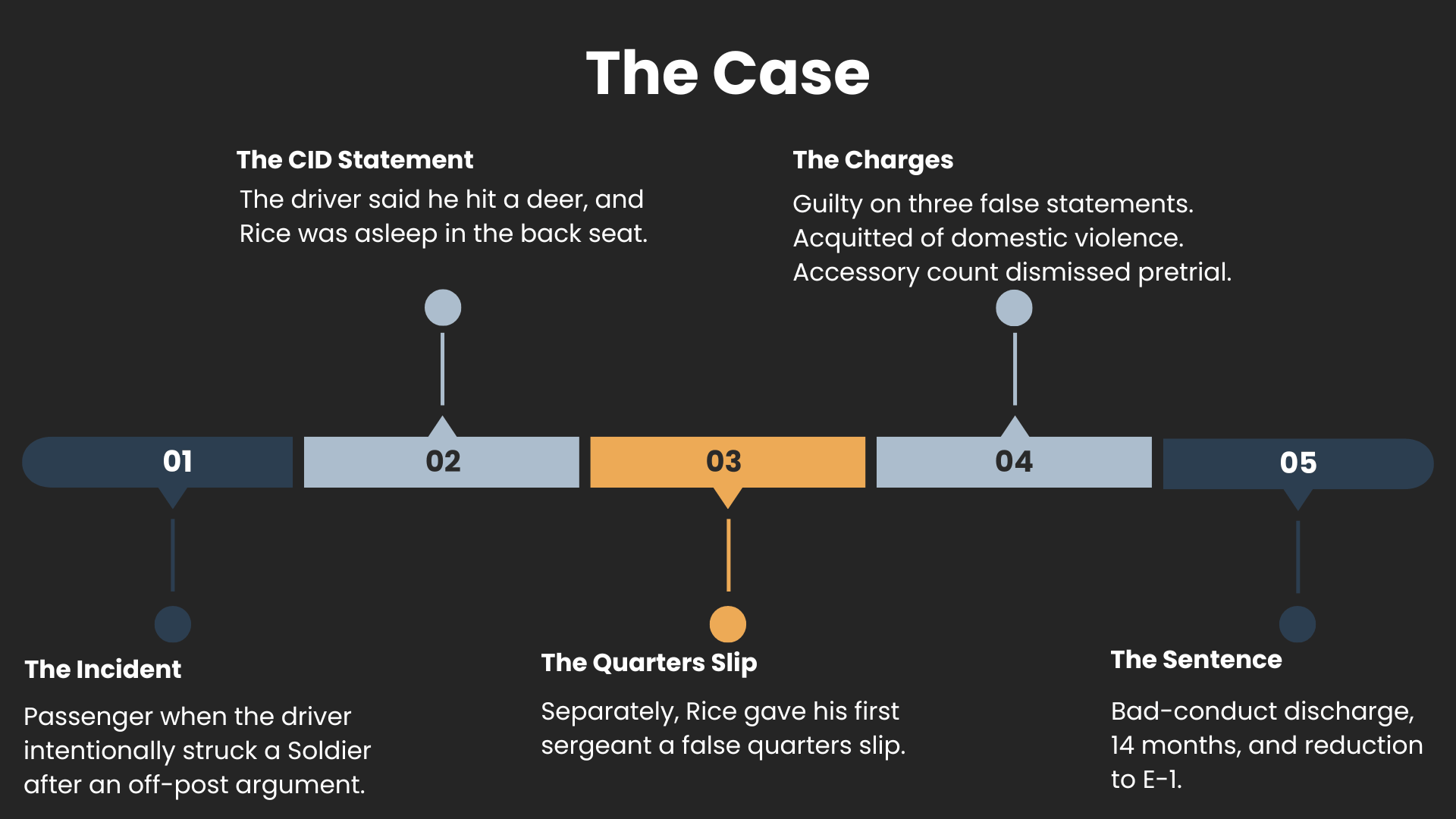
Specialist Isaiah M. Rice was a passenger in a car driven by another Soldier who intentionally struck a fellow Soldier after an argument off post in Kaiserslautern, Germany.
During the investigation, Rice told CID that the driver said he had hit a deer and that Rice himself had been asleep in the back seat.
Later, and unrelated to any of that, Rice handed his first sergeant a false quarters slip.
The Conviction and Sentence
An enlisted panel sitting as a general court-martial convicted him, contrary to his pleas, of three specifications of false official statement under Article 107, UCMJ.
Sentence: bad-conduct discharge, fourteen months, reduction to E-1.
He was acquitted of two Article 128b, UCMJ, domestic violence specifications, and an Article 78, UCMJ, accessory specification was withdrawn and dismissed before trial.
Where the Judicial Bias Claim Began: The Confrontation Clause Objection
The Government called a digital forensic examiner to talk about his report analyzing GPS data pulled from the infotainment system of the driver’s vehicle. Defense counsel asked for an Article 39(a) and objected on Confrontation Clause grounds: the examiner had only analyzed data that a different agent had collected. So far, textbook.
What followed is where the case gets interesting, and I am going to lay it out step by step, because the sequence is the whole argument.
Recess One: The Military Judge Sustains the Objection
The military judge told the Government it had to lay its foundation and asked how it intended to do it. He then ruled that the examiner’s testimony was insufficient because the Government never explained how the GPS data “got from Point A to Point B, Point B being Mr. [the examiner].” He sustained the defense objection. And then he offered both parties a recess to “reassess . . . if you have any evidence that’s going to establish the foundation for the GPS data.”
Recess Two: The Hash Value Fails
The Government came back with a modified exhibit. The military judge framed the question as “whether or not Mr. [the examiner] can establish that the information that he did an analysis on is the same information that [another law enforcement agent] collected.” The Government went at the alphanumeric hash value assigned to the data. It failed again, and the judge said if counsel “want[ed] a fast answer, the answer is going to be ‘no’” because the Government had not established the hash value assigned at collection.
Recess Three: The Sua Sponte Article 39(a) Session
The Government called the special agent who collected the data.
And during that testimony, the military judge, on his own motion, with no request from either side, excused the members and convened a 39(a) session, because he had noticed that the raw data “in some places refers to the identity of [the driver],” which caused him, in the court’s own words, “to wonder whether additional identifying information within the raw data might establish the identity of the vehicle and tie the data to [the driver’s] vehicle, thereby resolving the deficiencies in Mr. [the examiner’s] testimony.”
He then told counsel they would “also have to talk to [the agent] again to establish the brand of the vehicle, the model number or the serial number that’s in the property custody document.”
Read that again. The military judge noticed the fix, named the fix, and told the parties where to find the fix.
The Military Judge Gets the Report Admitted
After the recess, the Government reported back that yes, there were other identifying features in the data linking it to the vehicle, and yes, the agent could match them. Defense counsel kept the Confrontation objection alive. The military judge opined that the Government’s plan would overcome it.
The agent testified to the VIN, the examiner was recalled to match it, and the report came into evidence.
The Second Incident: Two Questions From the Military Judge
The second incident was smaller and, to my eye, more ordinary. On the quarters slip charge, the Government tried to admit a patient excusal note through a defense expert. Defense objected on foundation, because nobody had shown the note was ever given to Rice.
The military judge asked the doctor two questions: did you generate this for him, and did you give it to him or did somebody else? The doctor said yes, and “I was in the room when he received it.” The note came in.
The Contradiction That Matters on a Judicial Bias Appeal
Small housekeeping point that tells you something about how these opinions get built: at page four the court says the defense objection to the note “was overruled,” and at page six it describes the note as admitted “following a sustained defense objection.” Both cannot be right. It does not change the outcome. It is worth noticing anyway, because if you are the appellate advocate, an internal contradiction in the court’s own recitation is sometimes the thread you pull on reconsideration.
Plain Error Review: Why Waiting Until Appeal Is Fatal
Army Court of Criminal Appeals reviewed the claim for plain error review rather than on the merits (Martinez, 70 M.J. 154, 157 (C.A.A.F. 2011) (citing Jones, 55 M.J. 317, 320 (C.A.A.F. 2001))).
Under plain error review, the accused carries the entire burden and must establish three things (Clifton, 71 M.J. 489, 491 (C.A.A.F. 2013) (citing Powell, 49 M.J. 460, 464–65 (C.A.A.F. 1998))):
- There was error.
- The error was plain and obvious.
- The error materially prejudiced a substantial right.
Now hold that next to the law the court recited on the merits, because the contrast is the lesson.
What Is Judicial Bias Under R.C.M. 902?
Judicial Bias
Judicial bias is a judge’s actual or apparent partiality toward one side in a case. Under R.C.M. 902(a), a military judge must disqualify himself in any proceeding where his impartiality might reasonably be questioned. Actual bias is not required — the appearance of bias is enough.
An accused has a constitutional right to an impartial judge. R.C.M. 902(a) makes it operational: a military judge “shall disqualify himself or herself in any proceeding in which that military judge’s impartiality might reasonably be questioned” (Manual for Courts-Martial, United States (2024 ed.), R.C.M. 902(a), at II-111).
Actual bias is not required. The appearance of it is enough, because the system’s validity depends on impartiality “in fact and in appearance” (Uribe, 80 M.J. 442, 446 (C.A.A.F. 2021) (quoting Hasan v. Gross, 71 M.J. 416, 419 (C.A.A.F. 2012), and citing Norfleet, 53 M.J. 262, 270 (C.A.A.F. 2000))).
The test is objective: would a reasonable person knowing all the circumstances conclude that the judge’s impartiality might reasonably be questioned (Springer, 79 M.J. 756, 759–60 (Army Ct. Crim. App. 2020) (quoting Kincheloe, 14 M.J. 40, 50 (C.M.A. 1982))).
Two Details in the 2024 R.C.M. 902 Text
Two details in the current text are worth knowing cold, because a lot of counsel argue 902 from the case law and never open the rule.
R.C.M. 902(b)(3) separately disqualifies a judge who “has referred charges in the case,” alongside a judge who is the accuser or who forwarded charges with a personal recommendation as to disposition.
R.C.M. 902(c)(1) defines “proceeding” to include “pretrial (to include pre-referral),” trial, post-trial, and appellate review, which reaches pre-referral judicial proceedings that barely existed as a practice area a generation ago (MCM (2024 ed.) at II-111).
So we have a rule that triggers on appearances, and a review standard that demands obvious error and material prejudice.
Those two things do not fit together, and the mismatch is not an accident. Preserve the issue, and you litigate appearances. Sleep on it, and you litigate prejudice. Same facts. Different case entirely.
The Judicial Bias Cases the Court Relied On
The rest of the doctrine cuts the way you would expect. These are the judicial bias cases ACCA leaned on:
- Judges are presumed impartial, and the party trying to overcome the presumption faces a high hurdle (Quintanilla, 56 M.J. 37, 44 (C.A.A.F. 2001)).
- A military judge is not an “umpire in a contest between the Government and accused” (Id. at 43).
- The judge may participate actively — ask questions, clarify uncertainties, develop facts, and explain evidentiary requirements or the state of the record (Ramos, 42 M.J. 392, 396 (C.A.A.F. 1995)).
- Even questioning that resembles cross-examination may survive if it is limited and the whole record shows neutrality (Foster, 64 M.J. 331, 335–37 (C.A.A.F. 2007)).
- Occasional suggestions to counsel “do not in themselves make the military judge a partisan advocate,” and intervention to “prevent further fumbling and waste of the court’s time on a procedural matter involving obviously relevant and admissible evidence” is permissible (Zaccheus, 31 M.J. 766, 768 (A.C.M.R. 1990)).
What the Army Court of Criminal Appeals Actually Held
ACCA’s holding, stripped down: the military judge was performing his M.R.E. 104(a) gatekeeping duty.
He identified what was missing; he did not vouch for the evidence; he did not say it was true; and he did not relieve the Government of putting on the witness.
Active participant, not advocate.
I understand the reasoning. I even accept most of it. A military judge who rules “objection sustained” and refuses to say why is not being neutral; he is being useless, and he is building error into his own record. Telling both sides why a foundation fails is the job.
But there is a difference between diagnosing a defect and prescribing the cure, and United States v. Rice does not really engage with the moment the judge crossed from one to the other.
Look again at the sua sponte 39(a). Nobody asked for it. The Government had failed twice. The judge stopped the trial, sent the members out, and volunteered a theory of admissibility that the Government had not thought of, sourced from raw data the judge had been reading on his own. Then he told counsel what to go ask the agent. That is not explaining why a foundation is insufficient. That is building one.
The Army Court of Criminal Appeals answer is that this “form of intervention is consistent with a judge’s role as an active participant in the proceedings rather than advocacy,” and that a reasonable person knowing all the circumstances would not question the judge’s impartiality. Reasonable minds can differ, and mine does.
The Standard the Army Holds Its Own Military Judges To
Here is something the United States v. Rice opinion never mentions, and something I want every trial defense counsel to put in the next disqualification motion they write. The case law is not the only yardstick. The Army has published its own, and it is more demanding.
What the Military Judges’ Benchbook Says
Chapter 1 of the Military Judges’ Benchbook opens with the obligations of the office before it gets anywhere near pattern instructions (DA Pam 27-9, Military Judges’ Benchbook (2025), para. 1-1a, published on JAGCNet).
Subparagraph (2)(c): “Not Merely an Umpire”
Read subparagraph (2)(c) slowly, because it is Quintanilla with a second half that Quintanilla does not have:
“A judge is not merely an umpire between counsel. As a representative of justice, the judge is sworn to uphold the law and to ensure that justice is done. The judge should maintain the dignity of trial proceedings and preside with independence and impartiality. However, the judge should not unnecessarily interfere with or interrupt counsel”
DA Pam. 27-9, para. 1-1a(2)(c) (2025).
Appellate courts quote the first sentence constantly. I have never once seen the Government quote the last one. It is right there, in the Army’s own publication, in the same paragraph, and it is the counterweight. Not an umpire, yes. Also not a participant who interferes with counsel when there is no necessity for it.
Subparagraph (2)(d): Appearance and the Permanent Record
The next subparagraph is better still:
“The judge should avoid comment, conduct, or appearance that may unfairly influence court members or affect their judgment on the outcome of the case. The judge must endeavor to show restraint and understanding . . . bearing in mind that every word spoken during trial is not merely momentarily audible but is permanently recorded. The judge should therefore make certain that all statements are uttered with due regard not only for the immediate impact upon those present, but upon all those who may subsequently examine the record in close detail”
DA Pam 27-9, para. 1-1a(2)(d).
Appearance. Permanent record. Those who later examine the record in close detail. That is the objective test of R.C.M. 902(a), written in the Army’s own voice, addressed to the military judge himself.
Why the Benchbook Belongs in Your Disqualification Motion
A Benchbook is not binding law, and I am not going to pretend it is. It is a pamphlet, not a rule, and a judge who departs from it has not committed error by that fact alone. But it is the standard the Army’s own trial judiciary publishes for its own judges; it is signed by the Chief Trial Judge’s shop, and no military judge wants to read a defense motion quoting it back at him. Put it in the motion. Put it in the motion right after R.C.M. 902(a), and let the judge decide whether he wants to be the one who explains why the pamphlet does not apply to him.
A Friday Email From the Military Judge: A Case Study in Germany
Let me tell you about a case I tried in Germany, a case I tried in Germany during the same timeframe as United States v. Rice.
The Defect We Found — and the Decision to Wait
We had an Article 120, UCMJ, specification that was fatally defective. It did not state an offense. My co-counsel and I found it early; we papered it internally, and then we made a hard, deliberate, eyes-open decision: say nothing.
The plan was straightforward and, I still believe, correct. Let the Government open. Let them impanel and put the first witnesses on. Then ask for a 39(a), move to dismiss the specification for failure to state an offense, and watch it go away in a posture where the Government could not simply re-prefer and try again. That is not a trick. That is trial advocacy. The Government charges the case it chooses to charge, and it lives with the charge it drafted.
The Email That Arrived Three Days Before Trial
The Friday before trial was set to start on Monday, the military judge sent both parties an email, sua sponte:
“Does the Specification of Charge I allege an offense?
Please address relevant ancillary issues as necessary, including what constitutes a major change to a charge, and the limits of notice pleading.”
I was furious. I am not going to dress that up. Trial counsel was not tracking the defect. There is no version of that record in which they were. And the judge — with no motion before him, three days out from members — handed them the issue, told them the doctrinal boxes to fill, and gave them a weekend to fix it.
My client’s best defense to the most serious charge he faced evaporated in a two-line email sent from a government account on a Friday afternoon.
What Happened to the Case
I intended to voir dire the judge about it and object to him presiding. I had the outline. I never got to use it, because the case slipped, then slipped again, and the charges were eventually withdrawn and dismissed. My client went to an administrative separation board instead.
Good result for him. No judicial resolution for me.
Where I Landed, Years Later
I have thought about that email for years. Here is where I have landed, and it is more measured than what I felt at the time.
A military judge is entitled, and arguably obligated, to satisfy himself that a specification he is about to submit to members actually alleges a crime. No judge wants to preside over a conviction on a phantom charge. Raising the question so both parties can brief it is defensible.
Failure to State an Offense: How the Rule Changed in 2016
Worth knowing where these rules sit now, because they moved under our feet and a lot of good counsel are still working from the old map.
Failure to state an offense used to be a nonwaivable ground for dismissal at any stage. Then the President signed Executive Order 13730. It deleted R.C.M. 907(b)(1)(A)–(B), rewrote 907(b)(1) so that it reads, in full, “A charge or specification shall be dismissed at any stage of the proceedings if the court-martial lacks jurisdiction to try the accused for the offense,” and inserted a new R.C.M. 907(b)(2)(E): “The specification fails to state an offense” (Exec. Order No. 13730, 81 Fed. Reg. 33331, 33336 (May 26, 2016)).
One nonwaivable ground remains: jurisdiction. Failure to state an offense moved to the waivable column, where every 907(b)(2) ground “shall be dismissed upon motion made by the accused before the final adjournment of the court-martial in that case” (MCM (2024 ed.), R.C.M. 907(b), at II-119).
So the deadline in a contested case is final adjournment, and nothing in the rule requires you to move on the first morning. My team’s plan was inside the rule. We were not sandbagging. We were using the timing the rule allows.
And for former jeopardy purposes, the current Manual is specific about the moment that matters. A prior court-martial is not a “trial” in the sense of the rule unless, “[i]n the case of a trial with a military judge and members, the members have been impaneled” (MCM (2024 ed.), R.C.M. 907(b)(2)(C)(i)(II)). Impanelment, not the first question to the first witness. If you are running a timing play, know which clock you are watching.
The Problem Was Not That He Saw It
The timing of the judge’s email, and the audience for it, were choices, and they were not neutral ones. Raising it Friday for a Monday trial handed one party a repair window it had not earned. Raising it on the record at a 39(a), after jeopardy, with both sides present and a court reporter running, would have satisfied every institutional interest the judge had while preserving the posture the parties had actually litigated themselves into. Same question. Very different consequence.
My quarrel was never that he saw it. It was when he said it, and to whom, and in what forum.
How to Challenge a Military Judge for Bias: An 10-Step Guide
United States v. Rice tells you what happens if you do nothing: your judicial bias claim gets reviewed for plain error, and you lose. Here is the sequence I teach, and the one I use.
Know the Opening the Benchbook Already Gave You
Look at the script every Army military judge reads at the initial session. Benchbook para. 2-1-2:
“MJ: I am not aware of any matter that might be a ground for challenge against me. Does either side desire to question or challenge me?”
DA Pam 27-9, para. 2-1-2.
Then: “TC/DC: (Respond.)” That question gets asked in every general court-martial in the Army, and the answer is “No, Your Honor” roughly one hundred percent of the time, because at arraignment you have no reason to say anything else.
Fine. But understand what that exchange is and is not. It is not a one-time offer.
The Discussion to R.C.M. 902(d)(1) says grounds “may be raised at any time, and an earlier adverse ruling does not bar later consideration of the same issue” (MCM (2024 ed.), R.C.M. 902(d)(1) (Discussion)).
What you said at page 5 does not bind you at page 240.
Object to the Judge, Not Just the Evidence
This is the failure in United States v. Rice, and it is subtle enough that good counsel miss it.
The defense objected, repeatedly and correctly, on Confrontation Clause grounds. They preserved that. They did not preserve a challenge to the judge, because a Confrontation objection to an exhibit is not an objection to the military judge who helped get the exhibit admitted.
Two different rulings, two different standards of review, two different appellate lives. If your complaint is about the bench, you have to say so, out loud, on the record, in those words.
Raise It Early — and Raise It Again
Same Discussion, fuller quote:
“Possible grounds for disqualification should be raised at the earliest reasonable opportunity. They may be raised at any time, and an earlier adverse ruling does not bar later consideration of the same issue, as, for example, when additional evidence is discovered.”
So a military judge whose conduct is merely irritating in the morning and disqualifying by the afternoon is fair game in the afternoon. Cumulation is a legitimate theory. Raise it, note that you are raising it on the accumulated record, and describe each incident.
Get the Members Out First
Ask for the Article 39(a) session. Never litigate the military judge’s neutrality in front of the panel. You will look like you are whining to the referee, and members punish that.
Question the Military Judge
It is your right, not a favor:
“Each party shall be permitted to question the military judge and to present evidence regarding a possible ground for disqualification before the military judge decides the matter”
MCM (2024 ed.), R.C.M. 902(d)(2).
That is mandatory language.
You may examine the judge. You may put on evidence. Most counsel never do it once in a career, and the reluctance is understandable, because you are about to ask a colonel, on the record, whether he can be fair, and then spend the rest of the week in his courtroom. Do it anyway. Do it politely, do it precisely, and do it from a written outline so you do not wander.
Frame It Objectively, Never Personally
The standard is what a reasonable person knowing all the circumstances would conclude. So your motion is not “Your Honor is biased.”
Your motion is “Your Honor, a reasonable member of the public who read this transcript from page 214 to page 260 would question the impartiality of the proceeding, and R.C.M. 902(a) reaches appearances.”
You are not accusing him. You are describing a record. Judges can rule against a description of a record without feeling attacked. They rarely rule against themselves on an accusation.
Build the Record with Specificity and Quote
What the military judge said, what he did not say, who had moved for what, what the Government’s position was immediately before the intervention, and what it became immediately after.
In United States v. Rice, the killer facts were sequence facts: two failures, then an unrequested 39(a), then a theory of admissibility appearing in the judge’s mouth before it appeared in trial counsel’s. If that record had been made contemporaneously as a disqualification record rather than reconstructed on appeal from an evidentiary record, the appellate posture would look nothing like it does.
Make the Liljeberg Record
When bias is found, courts run a two-step: prejudice to substantial rights, and if not, whether reversal is warranted under Liljeberg v. Health Services Acquisition Corp., 486 U.S. 847, 864 (1988): the risk of injustice to these parties, the risk that denying relief produces injustice in other cases, and the risk of undermining public confidence in the judicial process (Martinez, 70 M.J. at 159–60).
Those are argument points, and they land better in a trial motion than in a brief written two years later by somebody who was not in the room.
Get a Ruling, and Get Findings
A denial with no reasoning is worth less to you on appeal than a denial with articulated findings you can attack. Ask for essential findings. If the military judge declines, note the declination on the record.
Do Not Waive It Accidentally
R.C.M. 902(e) lets the parties waive a 902(a) ground, but only after “a full disclosure on the record of the basis for disqualification” — and no military judge may accept a waiver of any 902(b) ground at all (MCM (2024 ed.), R.C.M. 902(e)).
If the judge makes a disclosure and asks whether the parties are satisfied, understand exactly what is being asked of you. That is a waiver colloquy. Silence is an answer.
Ask your client, on the record, and put the discussion on the record.
Then Keep Trying the Case
Once you have made the record, stop. Do not sulk, do not make a second career of it, and do not let the panel see that you are angry at the bench.
Try your case. The judicial bias cases that win on appeal are the ones where counsel did both: made the record, then tried the case anyway.
Why Preserving Judicial Bias Error Is Not the Same as Winning
Here is my bias, stated openly. I want every one of these issues preserved, cleanly, every time. Preservation is professional hygiene, and appellate counsel who inherit a clean record from a trial team will tell you it is the difference between a brief and a prayer.
But I do not want anybody reading this to walk away thinking the record is the point. It is not.
The accused in United States v. Rice got a full and fair appellate review from three judges who took the claim seriously enough to write six pages about it. He got nothing.
Even preserved, judicial bias claims are hard: the presumption of impartiality is real, the Quintanilla hurdle is high, and Ramos and Foster give judges a lot of runway to talk.
Preservation improves your odds. It does not create them.
The win is at trial. It is in the foundation objection that the Government cannot cure because you made it before they had a witness available to fix it. It is in the motion in limine filed early enough that the judge rules cold, on paper, without a panel waiting in the deliberation room and a docket breathing down his neck. It is in the timing decision my team made on that Article 120 specification, a sound decision that was ours to make and worth more than any assignment of error I could have written afterward.
Appellate courts affirm. That is what they do, most of the time, and the arithmetic is not going to change because you wrote a better brief.
So preserve everything. Object with precision, name the rule, question the judge when the rule entitles you to question the judge, and make a record that a stranger could read in two years and understand. Then go win the case in the room where the members are sitting, because that room is the only one where a Soldier’s future is actually still in play.
FAQ
What Relief Should Defense Counsel Request After Moving to Disqualify a Military Judge?
After moving to disqualify a military judge, defense counsel should request a ruling with essential findings, a halt to proceedings while the motion is decided, and relief tailored to any prejudice already created. That may include reconsideration of affected rulings, a curative instruction, or a mistrial when no lesser remedy can protect the accused (R.C.M. 905(d) requires essential findings where factual issues are involved; mistrial is governed by R.C.M. 915). Ask for what the record supports. No more, but certainly no less.
What Happens If a Military Judge Grants an R.C.M. 902 Motion During Trial?
If the military judge grants an R.C.M. 902 motion during trial, that judge should take no further action in the case except what is necessary to transfer it. Another military judge must be detailed, and the successor judge must address the governing substitution rules, the existing record, and any request to reconsider prior rulings or repeat proceedings. Disqualification does not automatically erase everything that came before it.
Which Military Defense Lawyer Handles Judicial Bias Cases in Germany?
The Law Office of Will M. Helixon handles judicial bias cases in Germany, representing Soldiers facing courts-martial in Kaiserslautern and throughout the country. Will M. Helixon is a retired Army JAG lieutenant colonel with more than 30 years of military justice and trial experience.
What Did the Army Court of Criminal Appeals Hold in United States v. Rice?
The Army Court of Criminal Appeals held that the military judge “was not coaching trial counsel on how to properly lay foundation and gave neither side any advantage or special assistance,” and that explaining why the government’s foundation was insufficient “was consistent with his responsibility of determining whether the proffered evidence was admissible” (United States v. Rice, ARMY 20240586, slip op. at 5 (Army Ct. Crim. App. 30 July 2026) (summ. disp.)).
Nothing in this post is legal advice, and no attorney-client relationship is created by reading it.